ITU
- Stands For
- International Telecommunication Union
- Easy Explanation
- The United Nations agency that acts as the referee for global wireless. It decides what each 'G' must achieve before anyone can call it that.
Module roadmap
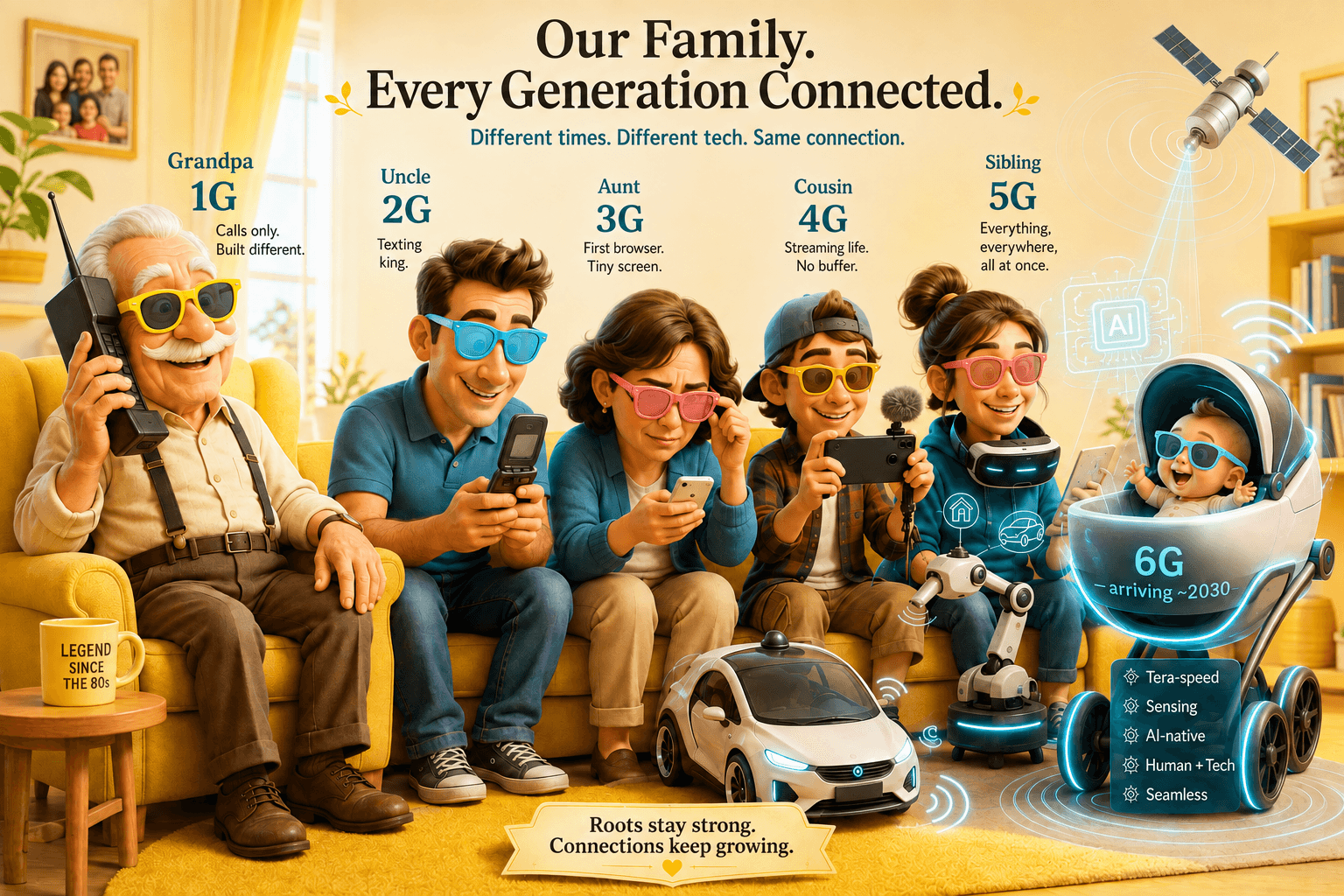
Picture a family reunion where every generation shows up. Grandpa 1G (1980s) could only make voice calls, on a phone the size of a brick, with the battery life of a mayfly. Uncle 2G (1990s) learned to text. Aunt 3G (2000s) brought the mobile internet, slow, but revolutionary. Cousin 4G (2010s) made video streaming and app stores normal; it's why ride-sharing and social video exist. Sibling 5G (2020s) added serious speed, low delay, and the ability to connect factories, cars, and millions of gadgets.
Now the family is expecting a new arrival around 2030: 6G. And like every new kid, it's expected to do everything the older ones did, plus things they never dreamed of: sensing the physical world, running AI natively, and connecting everywhere, including from space.
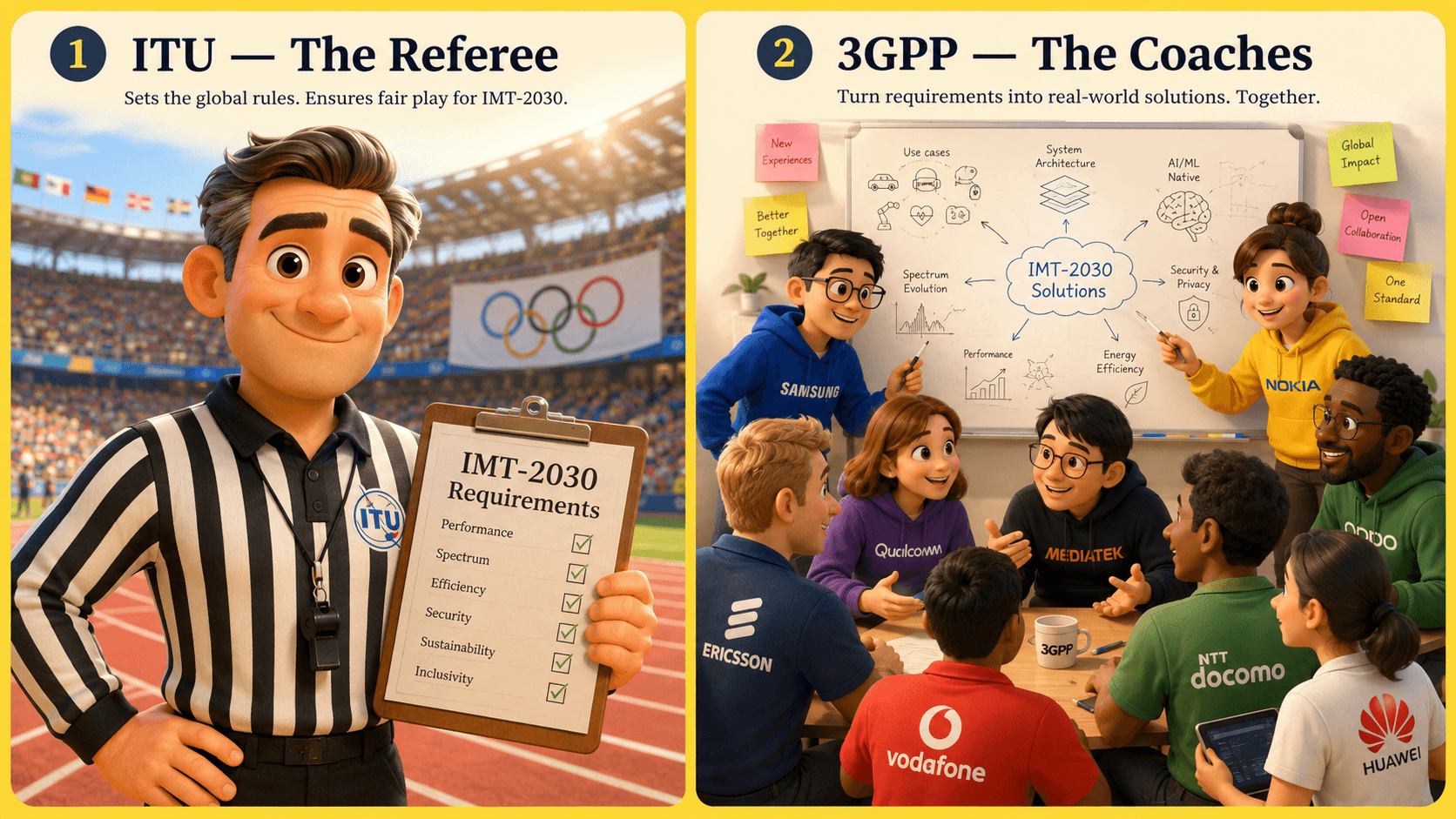
Marketing teams would love to slap '6G' on anything. Fortunately, there's a referee: the ITU, a United Nations agency. The ITU publishes a framework defining what the next generation must achieve. For 6G, that framework is called IMT-2030 (published in 2023). Think of the ITU as the Olympic committee: it doesn't train the athletes, but it defines the events and the qualifying standards.
The 'athletes' are trained by 3GPP, a global partnership of carriers, phone makers, and chip companies. 3GPP writes the excruciatingly detailed engineering recipes (standards) so that a phone built in one country works on a network in another. No 3GPP, no roaming, no interoperability, just chaos.
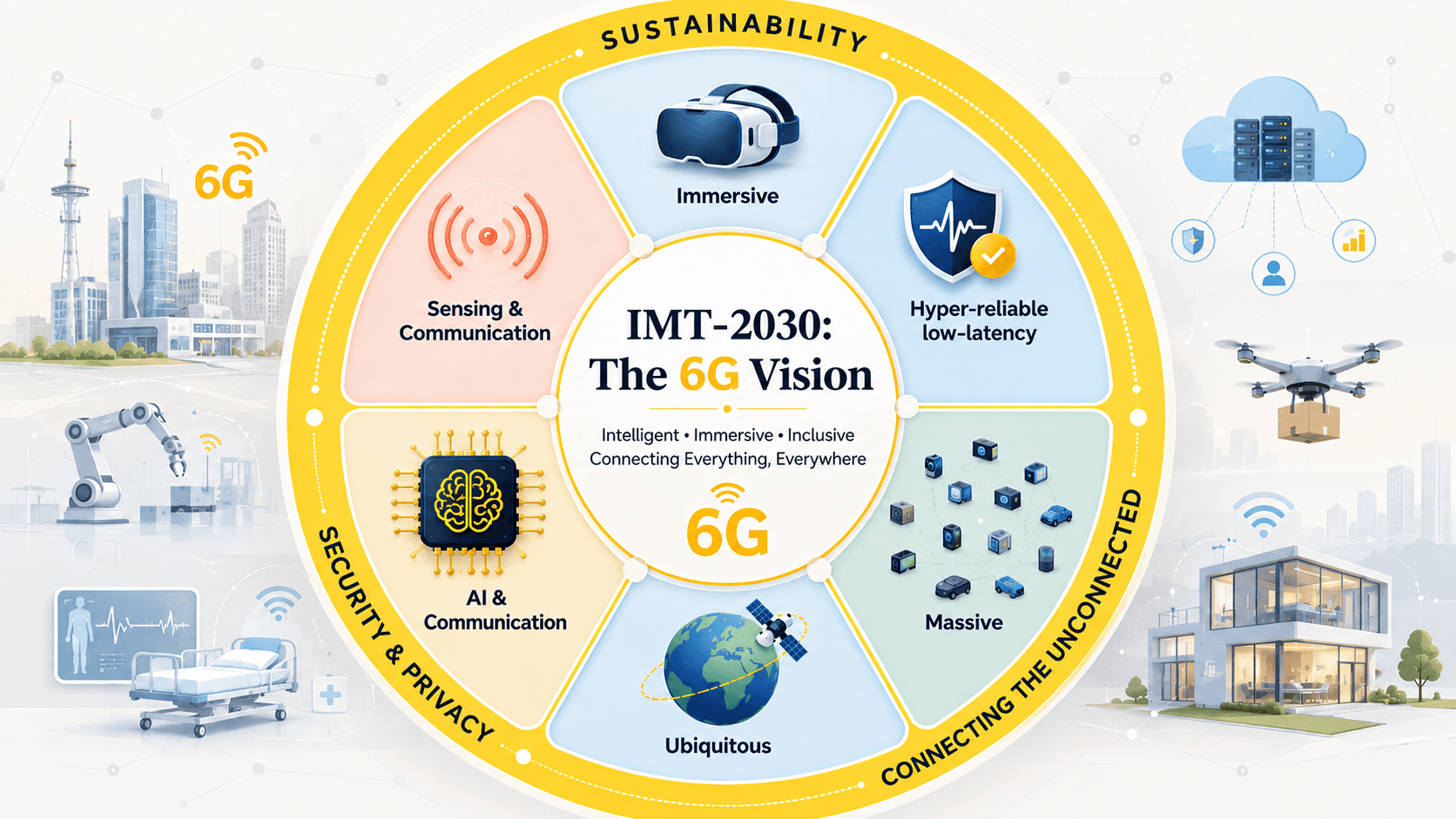
The ITU's 6G vision is usually depicted as a hexagon: six capability areas. Three are upgrades of 5G's promises, three are genuinely new:
Wrapped around the hexagon are cross-cutting goals every 6G design must respect: sustainability, security, resilience, privacy, and connecting the unconnected; Module 9 covers the first two in depth.
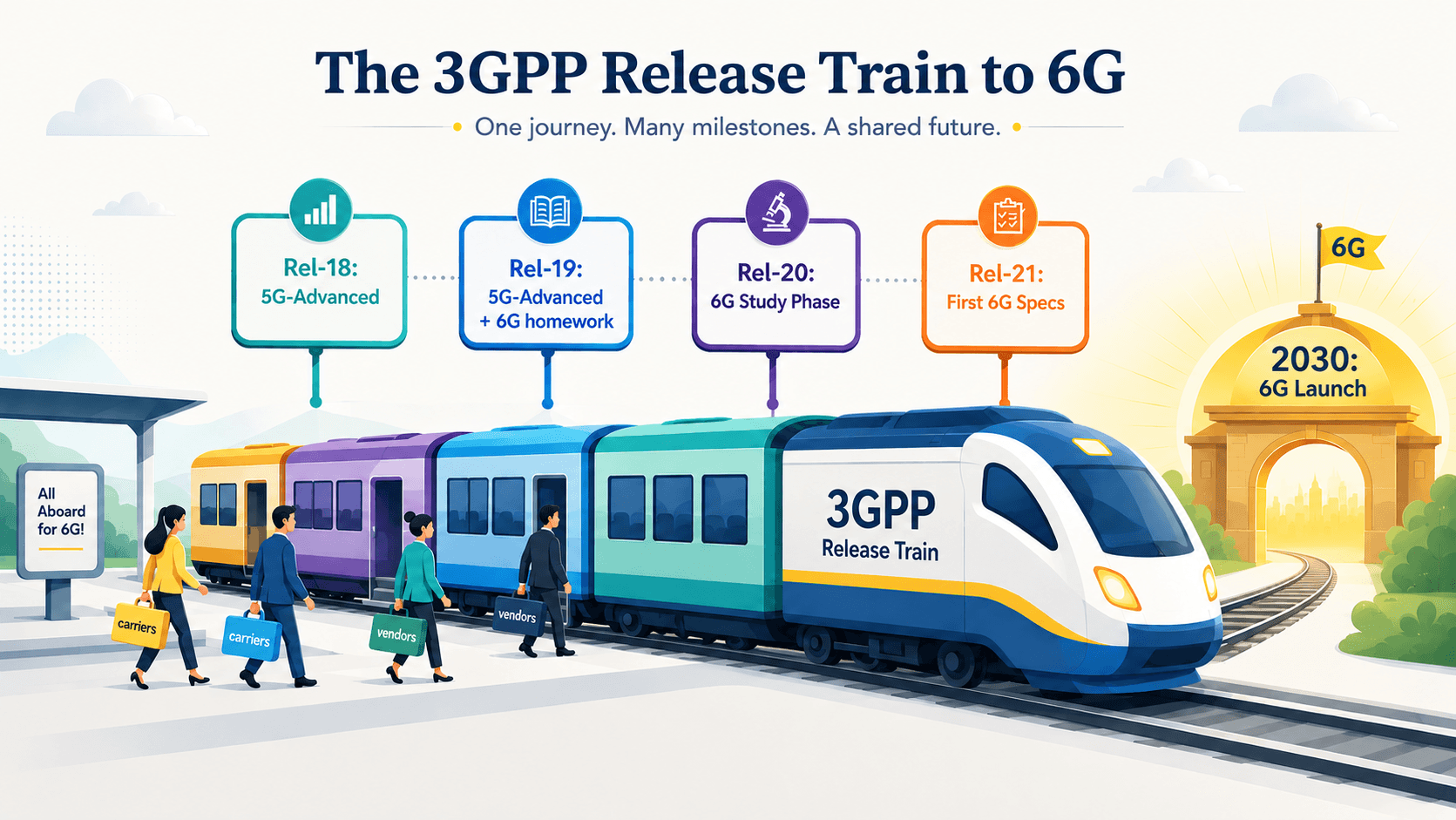
3GPP publishes standards like a train that departs on schedule, batch by batch. Each batch is a Release. Here's the stretch that matters for 6G:
Within 3GPP, work is divided among Technical Specification Groups (TSGs) and their Working Groups (WGs): think of them as departments and teams. When you hear an expert say 'RAN1 is debating the waveform,' they mean a specific working group arguing about a specific recipe ingredient.
Keep this handy
| Acronym | Stands For | Easy Explanation |
|---|---|---|
| ITU | International Telecommunication Union | The United Nations agency that acts as the referee for global wireless. It decides what each 'G' must achieve before anyone can call it that. |
| IMT-2030 | International Mobile Telecommunications for 2030 | The ITU's official name and wish list for 6G. If a technology meets this list, it earns the 6G badge. |
| 3GPP | 3rd Generation Partnership Project | The world's biggest engineering club (carriers, phone makers, chip makers) that writes the detailed recipes, the standards, for how mobile networks actually work. |
| RAN | Radio Access Network | Everything between your phone and the internet's front door: the tower antennas, the radios, and their controllers. |
| NR | New Radio | The official name of the 5G radio system. 6G's radio will be its successor. |
| Rel-XX | Release (e.g., Rel-20) | 3GPP publishes its recipes in numbered batches called Releases, like software versions. Rel-20 starts the formal 6G studies; Rel-21 writes the first 6G specs. |
| TSG / WG | Technical Specification Group / Working Group | The committees inside 3GPP. TSGs are the departments; WGs are the teams inside them doing the detailed homework. |
| KPI | Key Performance Indicator | A measurable target, like 'top speed' or 'delay.' Each generation is defined by the KPIs it must hit. |
Knowledge check