ISAC
- Stands For
- Integrated Sensing And Communication
- Easy Explanation
- The network does two jobs at once: it sends your data AND acts like radar, detecting objects around it. Like a lifeguard who also delivers snacks.
Module roadmap
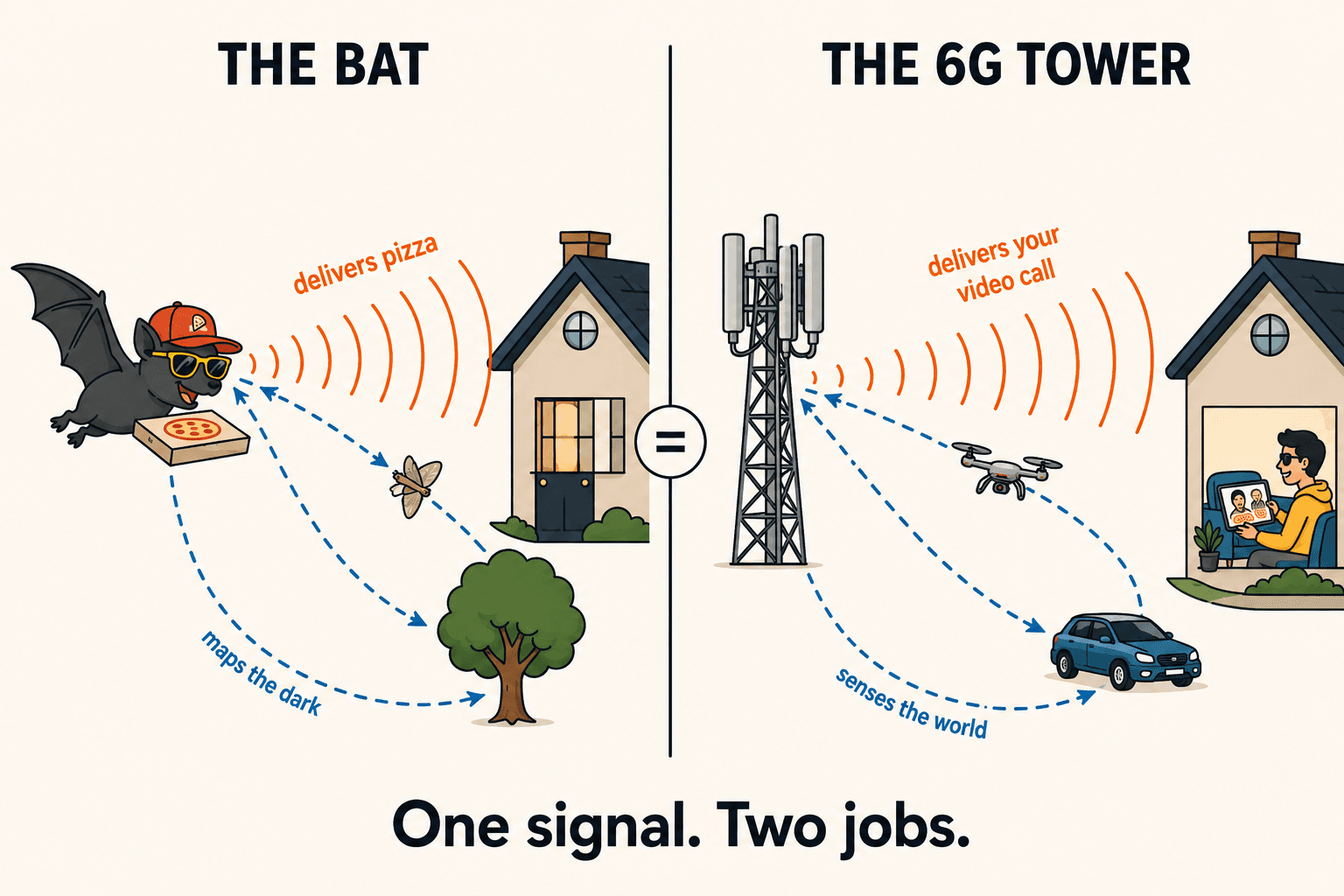
Imagine a bat. Bats send out sound waves, listen to the echoes, and build a picture of the world, that's echolocation. Now imagine that same bat is also your pizza delivery driver, dropping off dinner while it maps the neighborhood. It does both jobs with the same set of wings and the same squeaks.
That's ISAC. Today, cell tower antennas have one job: move your data (the pizza). With ISAC, the same radio waves that carry your video call also bounce off objects, cars, drones, people, raindrops, and return echoes. The network reads those echoes and 'sees' its environment. One signal, two jobs: communication + sensing.
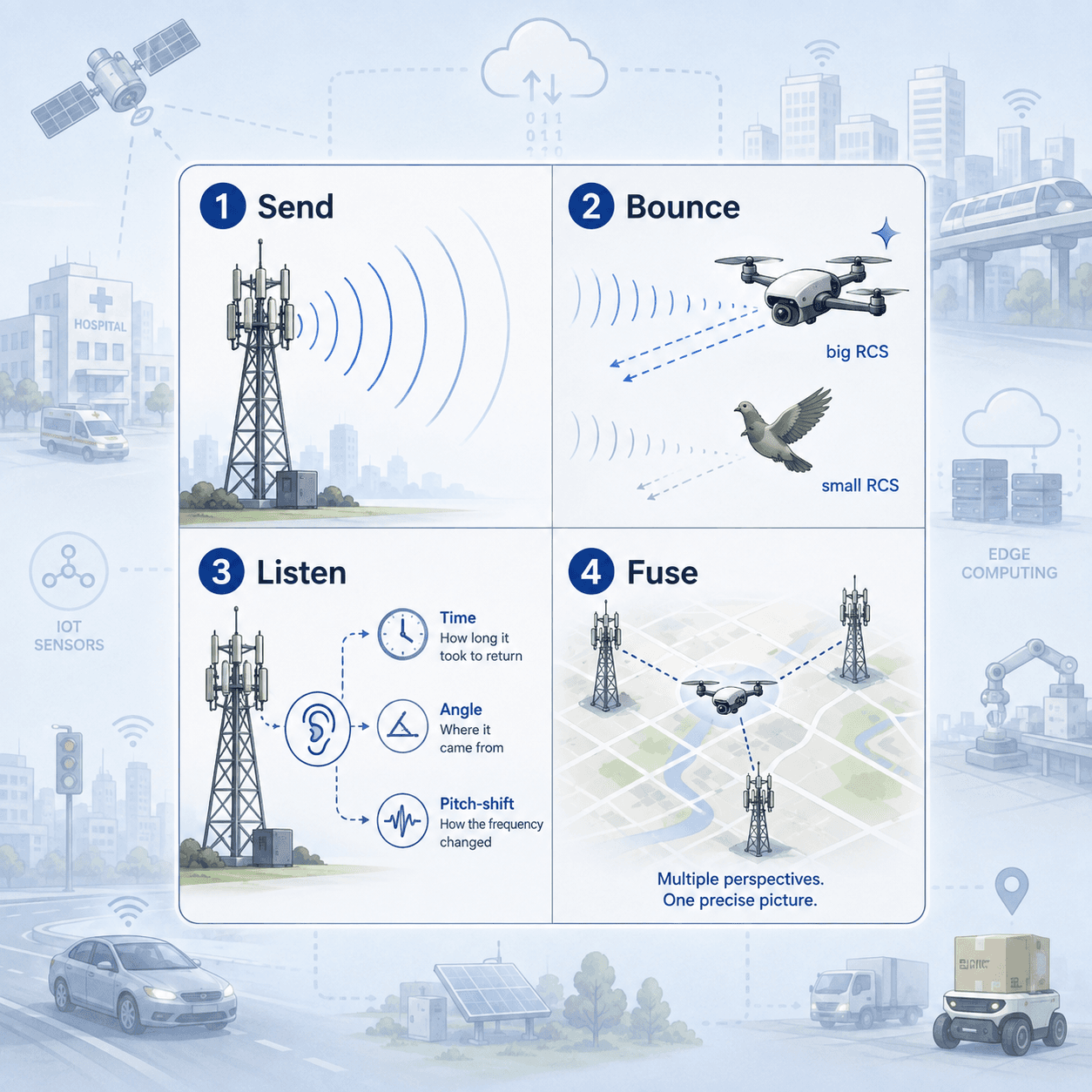
The base station (3GPP calls it a gNB, see the Acronym Decoder) transmits radio waves as usual.
Some waves hit objects and reflect back. How strongly an object reflects is its Radar Cross Section (RCS). Think of shining a flashlight around a dark room: a mirror bounces the light straight back at you, while a black sweater swallows it. RCS is simply a number for how much of the radio 'flashlight' an object bounces back, big number, easy to detect; tiny number, nearly invisible. A metal drone is like a disco ball, flashy, easy to spot. A pigeon is like a matte-black yoga mat, barely reflects anything.
The tower measures three things from the echo: how long it took (distance), which direction it came from (angle), and how the frequency shifted (speed, the Doppler effect). Here's the Doppler effect in plain terms:
It's why an ambulance siren sounds high as it approaches and suddenly drops as it passes. Radio waves do the exact same thing, so the amount of 'squish' or 'stretch' in the echo tells the network how fast the object is moving, and in which direction.
I have added a section at the end of this module (before the quiz) to explain the Doppler Effect further.
Multiple towers (i.e., antennas) share echoes and combine them, like three friends describing a stranger from different angles until you have a full picture. This multi-tower teamwork is a major topic in 3GPP's 6G study work (Release 20).
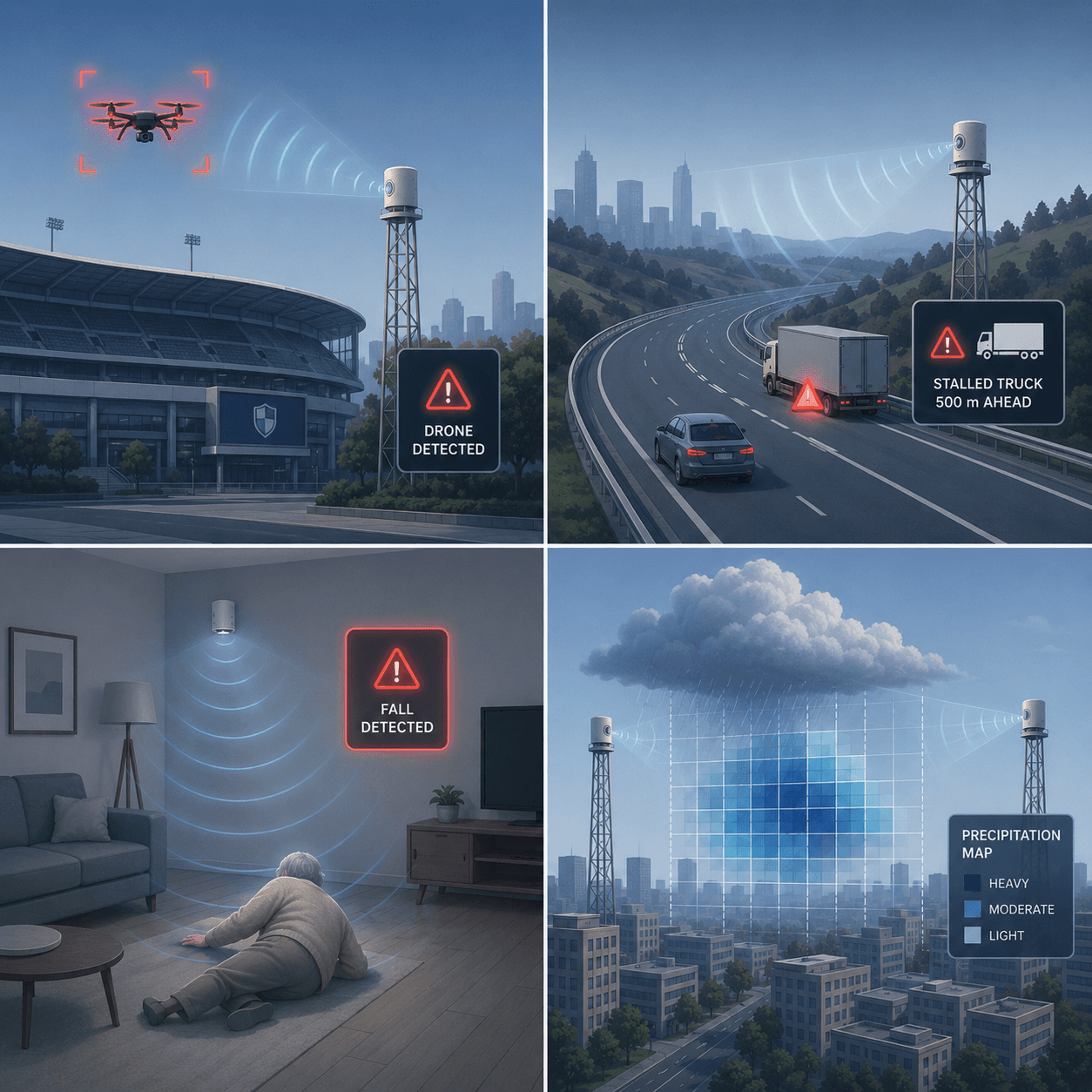
Airports and stadiums need to spot rogue drones. Dedicated radar is expensive; cell towers are already everywhere. ISAC lets the existing network flag a drone the moment it crosses a fence line, even if the drone's owner never connected it to anything.
Towers along a highway can sense vehicle positions and speeds, including old cars with zero connectivity, and warn connected cars about a stalled vehicle around a blind curve. Think of the network as a crossing guard with X-ray vision.
Radio echoes are sensitive enough to detect a wave of your hand, a fall in an elderly person's home, or whether a room is occupied (great for energy savings). Your walls get a sixth sense, no cameras, which is a privacy win.
Rain, fog, and even flooding change how radio waves travel. A dense network becomes a citywide weather instrument, spotting a microburst street by street instead of relying on a single distant weather radar.
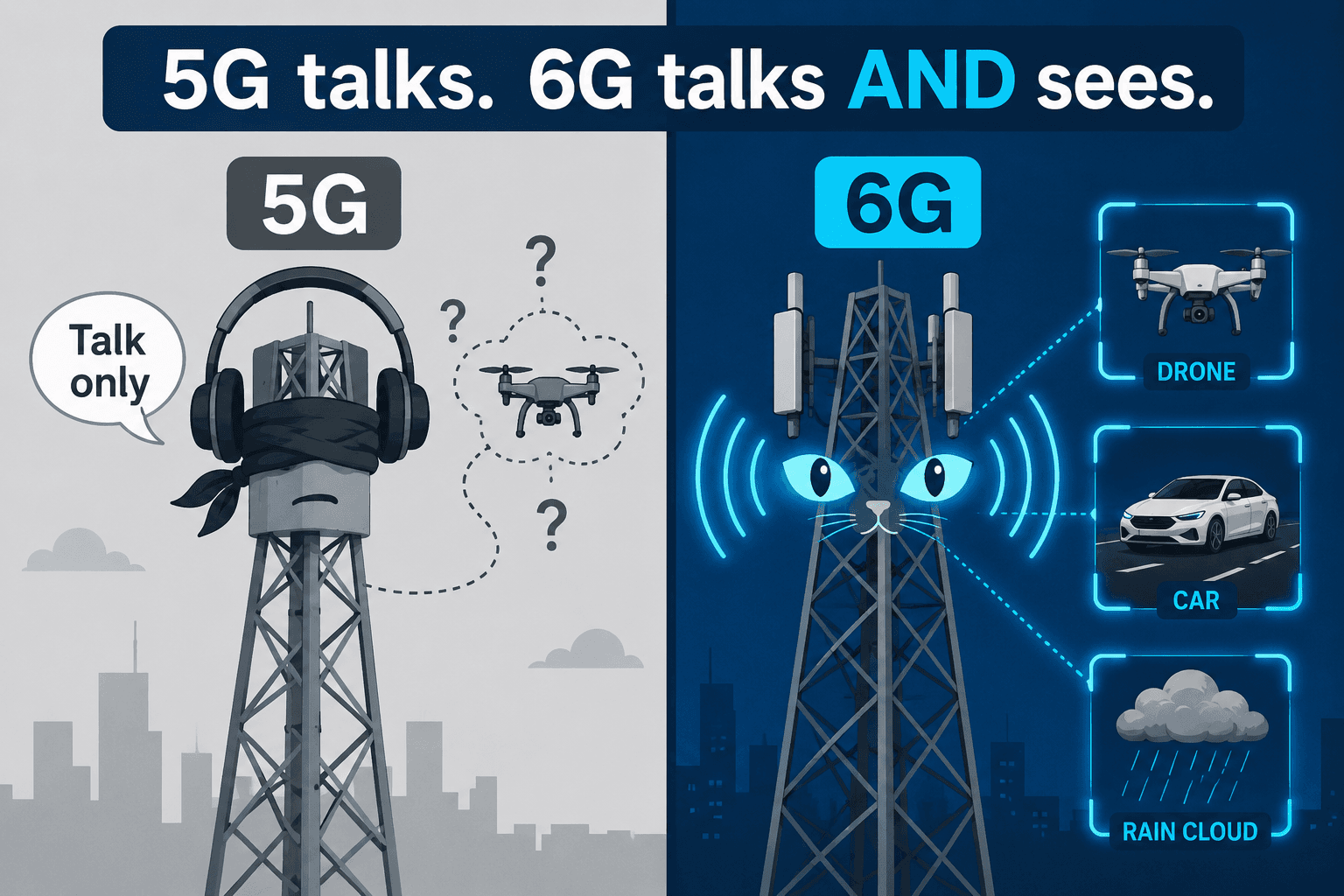
5G is a brilliant talker but a lousy watcher. Its waveforms, scheduling, and tower antennas were all optimized for one thing: moving bits to devices (UEs) that ask to be talked to. Sensing needs things 5G never planned for:
Where it stands in the standards world: 3GPP began studying ISAC channel modeling in Release 19, and ISAC is a headline study area in Release 20, the release that kicks off formal 6G study items, with the first 6G specifications targeted for Release 21, aligned to the ITU's IMT-2030 framework (commercial 6G around 2030).
Keep this handy
| Acronym | Stands For | Easy Explanation |
|---|---|---|
| ISAC | Integrated Sensing And Communication | The network does two jobs at once: it sends your data AND acts like radar, detecting objects around it. Like a lifeguard who also delivers snacks. |
| JCAS | Joint Communication And Sensing | Another name for ISAC is used in research papers. Same idea, different label. Like 'soda' vs. 'pop.' |
| RCS | Radar Cross Section | How 'visible' an object is to radio waves. A metal drone reflects a lot (big RCS); a bird reflects little (small RCS). Think of it as how shiny something looks to the network's radar eyes. |
| gNB | next-generation NodeB (the base station) | The radio brain at the tower site. In 6G, it doesn't just talk to phones, it also senses its surroundings. |
| UE | User Equipment | 3GPP's fancy word for your phone (or any connected device). |
| LiDAR | Light Detection And Ranging | Sensing with lasers instead of radio. Self-driving cars use it. ISAC does something similar, but with the radio waves already flying around. |
| Doppler (effect) | Not an acronym, a physics effect | Waves bounced off a moving object shift in frequency. It's why an ambulance siren changes pitch as it passes you. ISAC uses this to measure speed. More explanation next. |
| 6DoF | Six Degrees of Freedom | Tracking position (x, y, z) plus rotation (pitch, yaw, roll). Full 3D awareness of where something is and which way it's facing. |
The Doppler effect in wireless transmission is the change in the frequency or pitch of a radio signal that happens when the transmitter and receiver are moving toward or away from each other. It is the exact same physics principle that makes a siren sound higher-pitched as an ambulance speeds toward you, and lower-pitched as it drives away.
Modern wireless networks (like 4G, 5G, and Wi-Fi) use advanced math and smart receiver designs to track and cancel out these shifts. The receiver constantly measures the device's speed and adjusts its tuning to perfectly match the incoming signal.
Knowledge check