DT
- Stands For
- Digital Twin
- Easy Explanation
- A live virtual copy of a real thing (a factory, a city block, a jet engine) that updates in real time and can run 'what-if' experiments safely.
Module roadmap
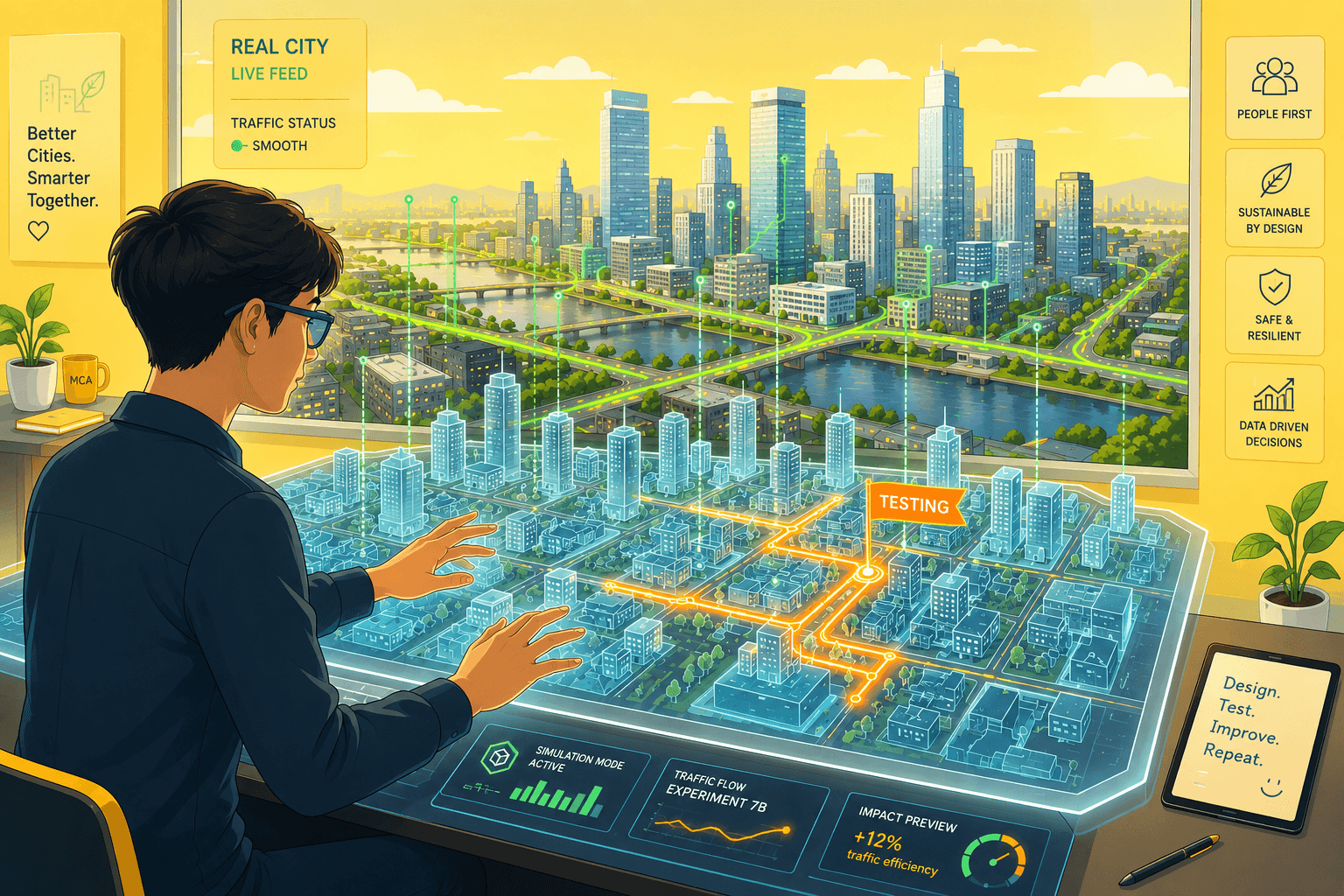
Remember SimCity, build a city, try things, and if traffic melts down, no real commuters suffer? A digital twin is the concept aimed at reality: a live virtual replica of a factory, a port, a power grid, or an entire downtown, continuously fed by real sensors. The magic word is live. A 3D model is a photograph; a digital twin is a video call with reality.
What twins are for: trying dangerous or expensive things safely. Reroute a city's traffic lights virtually before touching the real ones. Stress-test a factory line at double speed. Watch a virtual bridge accumulate strain and schedule repairs before the real one cracks. The twin absorbs the mistakes, so reality doesn't have to.
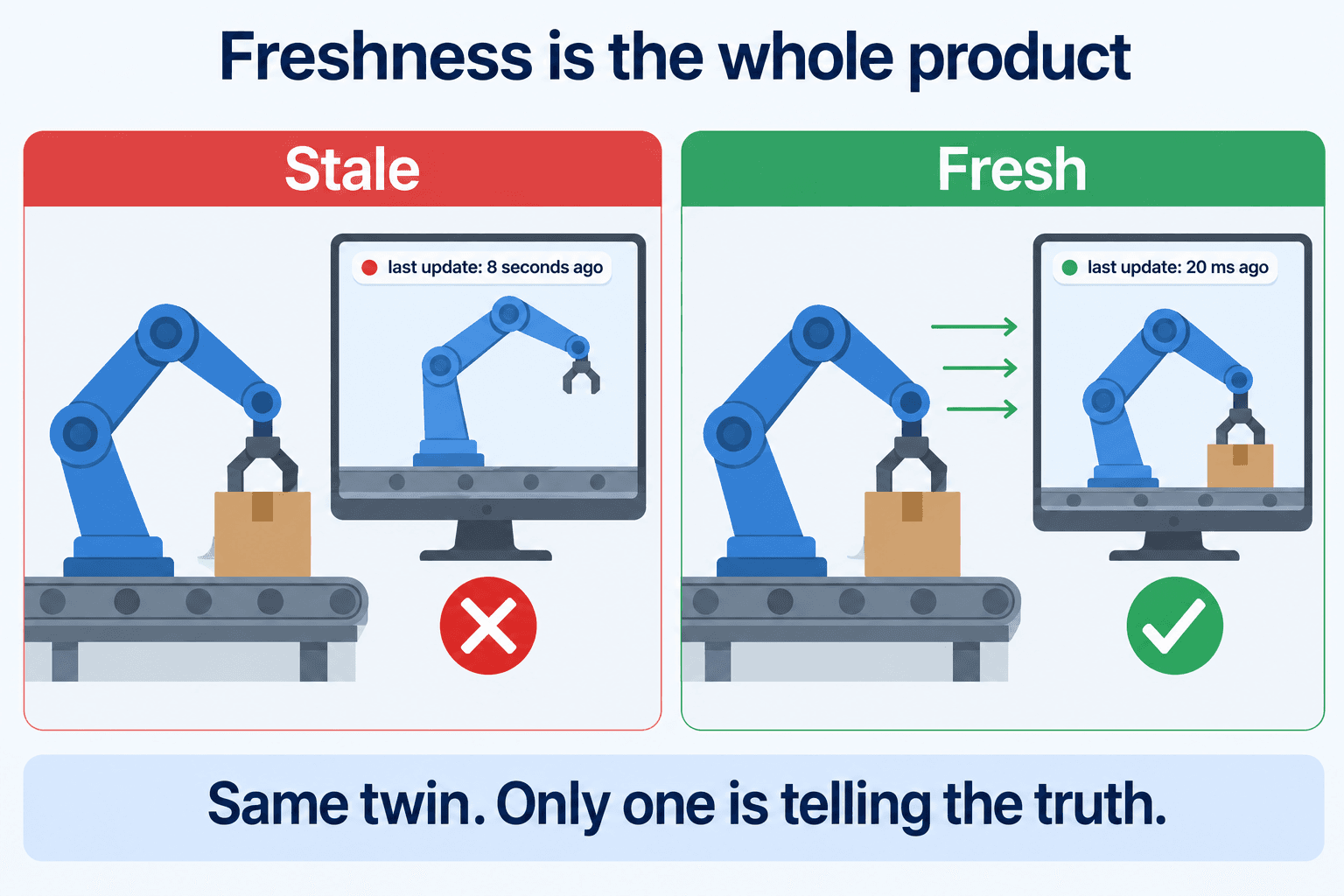
A twin's only real currency is trust, and trust requires freshness. If the virtual factory shows a robot arm at position A while the real arm has moved to position B, decisions based on the twin are, in effect, decisions based on fiction. Engineers even have a metric for this, the age of information: not 'how fast can data travel' but 'how stale is my current picture of reality?'
That means the network's job isn't just speed, it's keeping thousands of tiny update streams flowing without gaps, prioritizing the updates that matter (the overheating motor) over the ones that don't (the thermostat in a stable room). This blends everything you've met so far: sensing (Module 2) feeds the twin, and reliable low-latency links carry the critical updates.
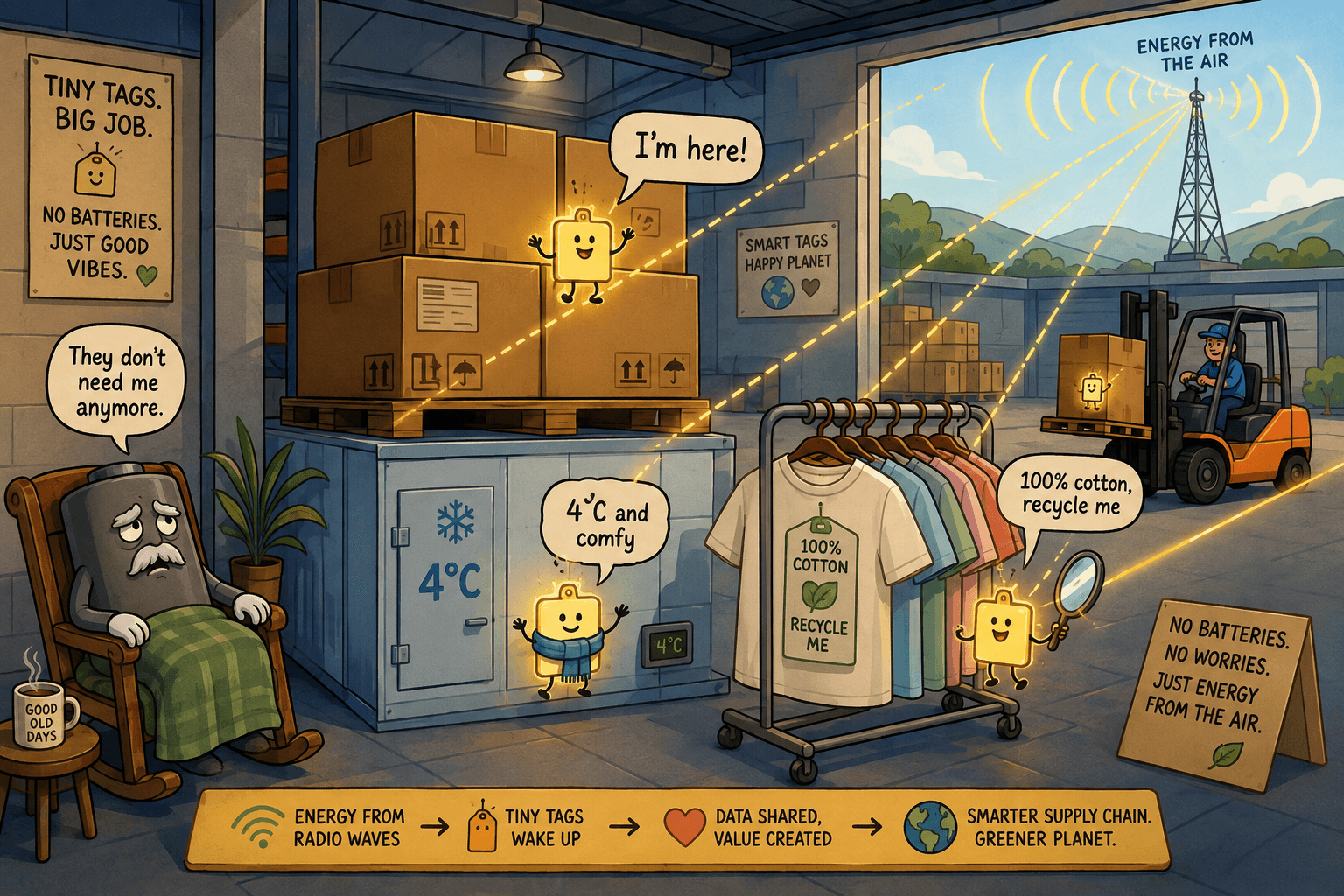
Here's the problem with connecting everything: batteries. Ten billion battery-powered sensors mean ten billion battery replacements, an ecological and logistical nightmare. Enter Ambient IoT (A-IoT): tags so frugal they live off ‘scavenged’ energy, harvesting power from radio waves, light, heat, or vibration, like a solar calculator that never asks for anything.
How can they transmit without a power source? Mostly they don't, they use backscatter: reflecting radio waves that already fill the air (from tower antennas or phones) and subtly modulating the reflection to encode data. It's the difference between owning a flashlight and signaling with a pocket mirror using someone else's sunshine. Your store's anti-theft RFID tag is the primitive ancestor; A-IoT extends the idea to longer ranges and full network integration, 3GPP began standardizing Ambient IoT in Release 19, with 6G expanding it.
What it unlocks: every package in a supply chain reporting its location and temperature; every garment telling the recycling plant what it's made of; every pallet, tool, and crate findable instantly. Logistics people get visibly emotional about this.
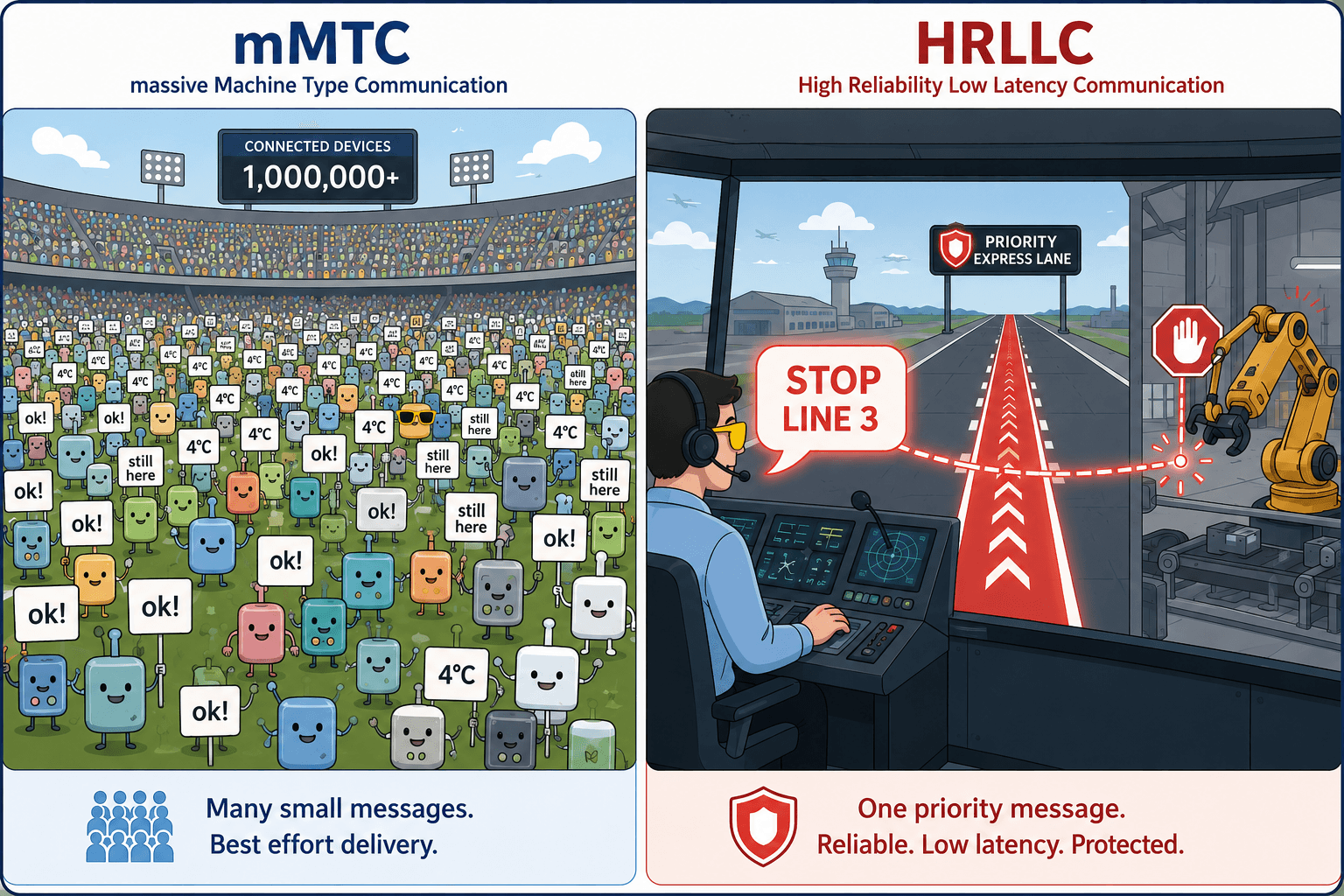
6G must master two opposite connection styles, and confusing them is a classic rookie mistake:
A digital twin typically needs both: an mMTC swarm of humble sensors painting the background picture, plus a few HRLLC lifelines for the moments when the twin must slam the brakes on a real machine right now.
Keep this handy
| Acronym | Stands For | Easy Explanation |
|---|---|---|
| DT | Digital Twin | A live virtual copy of a real thing (a factory, a city block, a jet engine) that updates in real time and can run 'what-if' experiments safely. |
| A-IoT | Ambient IoT | Tags and sensors so cheap and low-power they need NO battery, they harvest energy from radio waves or light, like a solar calculator's tiny cousin. |
| NB-IoT | Narrowband Internet of Things | Think of it as a special, super-low-energy cellular network designed for everyday objects rather than humans. NB-IoT gives these devices a slow but incredibly reliable path to the internet, allowing their batteries to last for up to 10 years without needing a charge. |
| mMTC | massive Machine-Type Communication | The art of connecting an enormous crowd of simple devices that each say very little, very rarely, quantity over chattiness. |
| HRLLC | Hyper-Reliable Low-Latency Communication | 6G's upgrade of 5G's URLLC: messages that arrive fast AND essentially always, for robots, grids, and surgery, 'almost always' isn't good enough. |
| RFID | Radio-Frequency Identification | Today's battery-free tags (like anti-theft tags in stores). Ambient IoT is RFID's ambitious grandchild: longer-range, smarter, and network-connected. |
| Backscatter | Not an acronym, a technique | Instead of transmitting its own signal, a tag reflects and subtly modifies radio waves already in the air, like signaling with a mirror instead of owning a flashlight. |
| URLLC | Ultra-Reliable Low-Latency Communication | 5G's version of the dependable-and-fast promise. HRLLC is 6G, raising the bar. |
| CPS | Cyber-Physical System | Any setup where computers sense and control real-world machinery, the umbrella concept digital twins live under. |
Knowledge check