AI/ML
- Stands For
- Artificial Intelligence / Machine Learning
- Easy Explanation
- Software that learns patterns from data instead of following hand-written rules, the network's new apprentice that gets better with experience.
Module roadmap
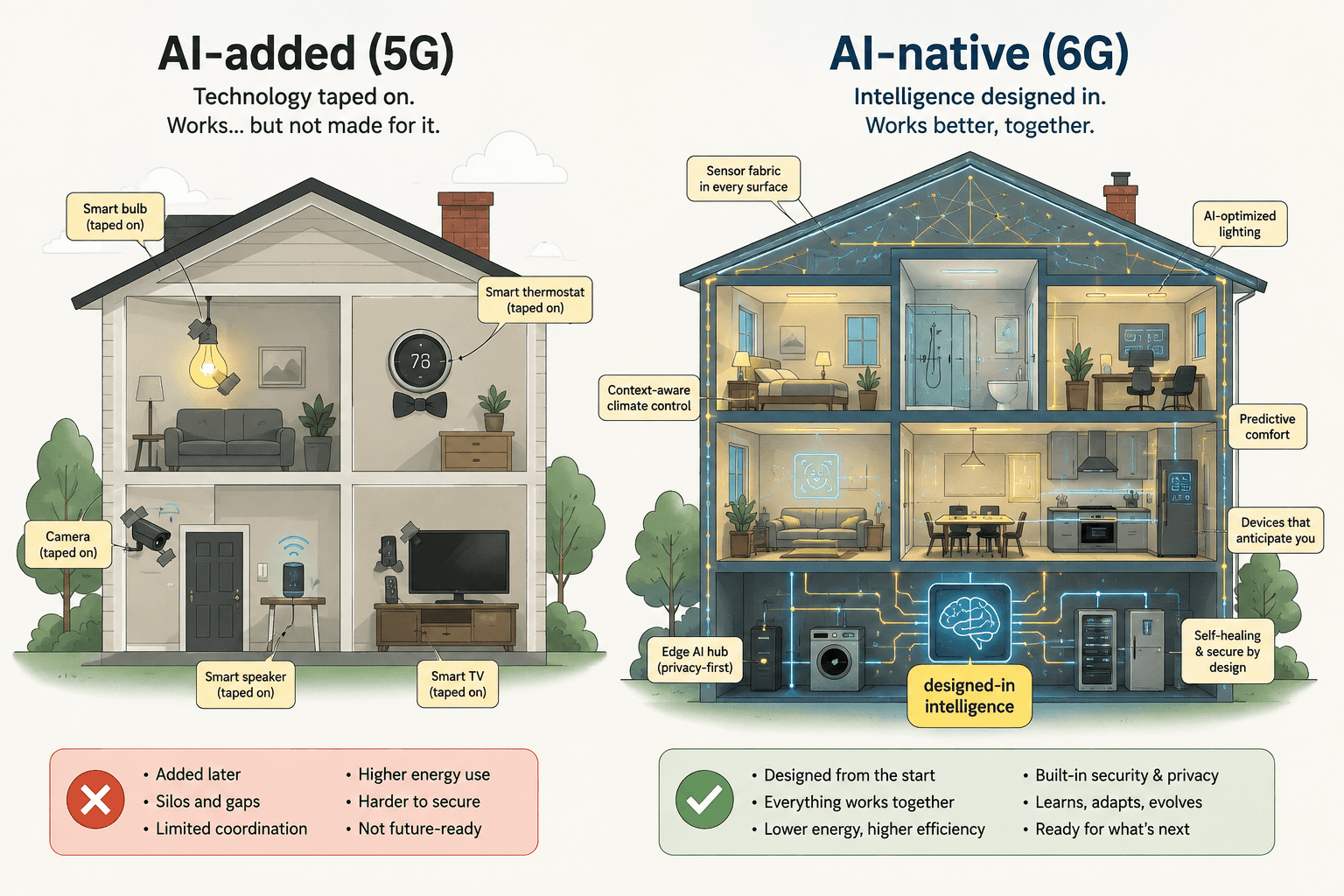
5G was designed by humans writing rules, and AI was later invited in as a helpful guest, optimizing here, predicting there. 6G flips the philosophy: AI-native means the network is designed from day one assuming AI will run key parts of it. The analogy: 5G is a house where you added smart bulbs and a learning thermostat; 6G is a house architected around automation, sensors in the walls, wiring designed for it, rooms that expect to be managed by software.
Concretely, AI-native shows up in three layers, which the next lessons walk through: AI in the radio itself (Lesson 7.2), AI running network operations (7.3), and, completing the circle from Module 1's hexagon, the network as a delivery platform for AI, carrying and hosting AI workloads for users and industries.
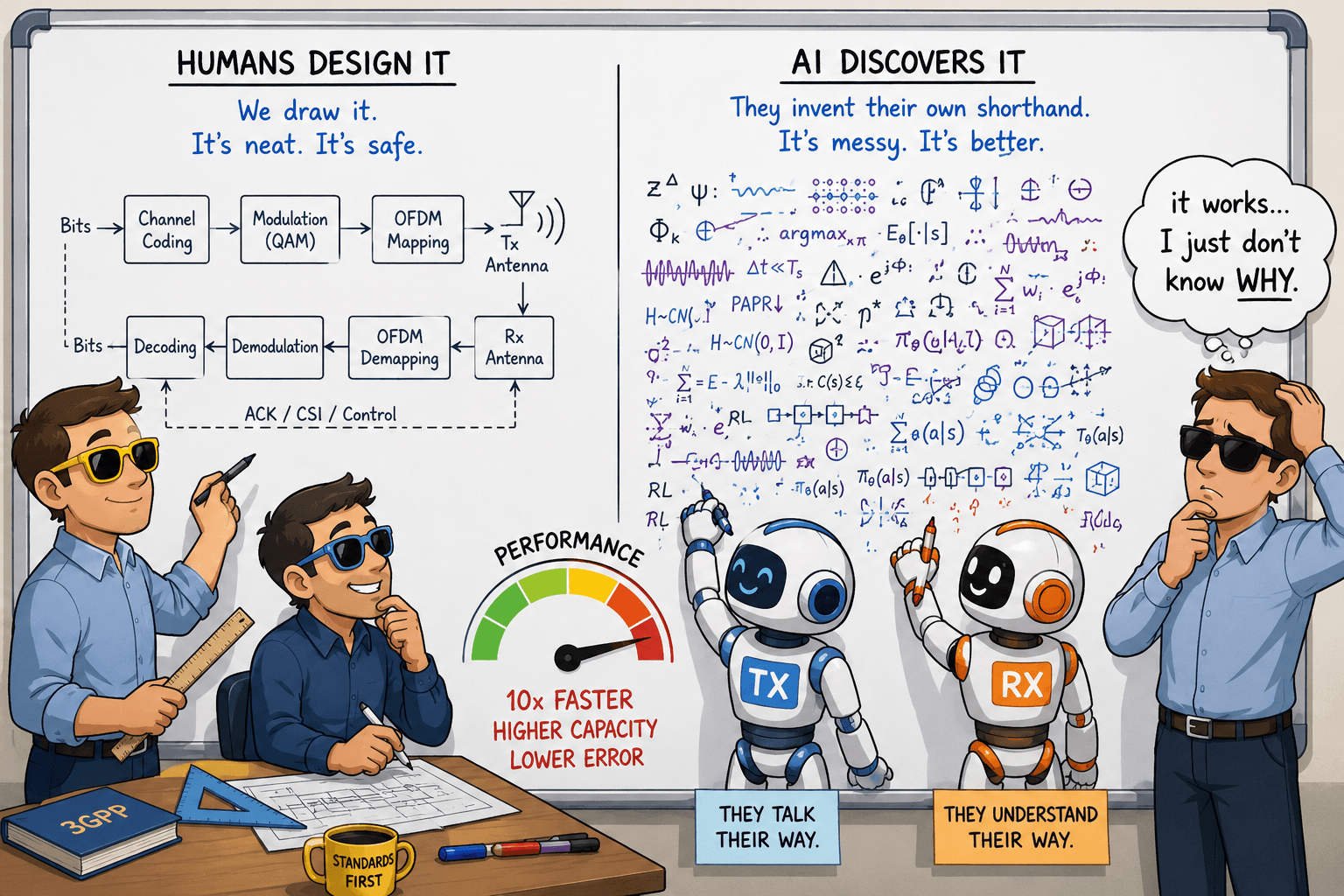
Decades of brilliant humans hand-crafted how radios estimate channels, form beams, and decode signals. Real radio environments with millions of parameters constantly changing are far messier than any textbook model. Since AI/ML (AI & Machine Learning) excels in finding, learning, and applying patterns it’s an ideal tool for organizing this mess. The flagship examples (and the exact ones 3GPP studied in Rel-18/19 as 'AI/ML for the NR air interface'):
The endgame idea, genuinely 6G, is the AI-designed air interface: letting the AIs of transmitter and receiver learn parts of the signaling scheme together, discovering encodings no human would draw on a whiteboard. Think of two people who've worked together for 20 years developing their own shorthand, unintelligible to outsiders, ruthlessly efficient between them.
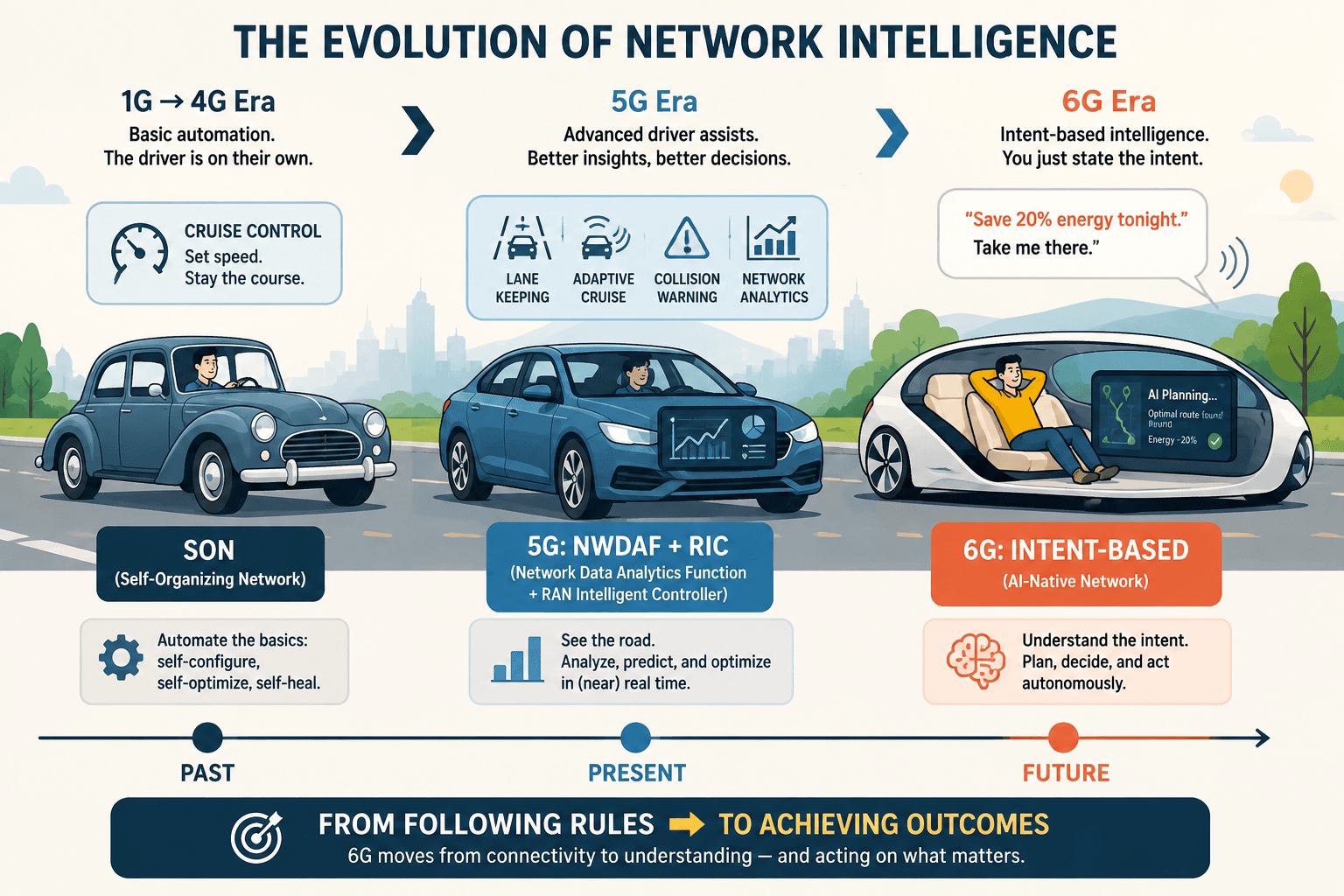
Networks are colossal machines, thousands of sites, millions of parameters, and traffic that shifts hourly. The automation journey mirrors cars: SON (self-organizing networks) was cruise control, handy rule-based scripts. 5G added smarter assists: the NWDAF analytics brain in the core, and the RIC, an intelligence layer from the O-RAN ecosystem where optimization apps observe the radio network and tune it. 6G aims for genuine self-driving: intent-based operation, where a human states the goal ('cut energy 20% tonight without hurting emergency services') and the network's AI figures out the thousand knob-turns to achieve it.
Two supporting ideas complete the picture. First, the network keeps a digital twin of itself (Module 4's concept, aimed inward): AI rehearses changes on the twin before touching production, a flight simulator for network operations. Second, learning happens without hoarding private data: techniques like federated learning let sites and devices train a shared model by exchanging model updates, not raw user data.
An honest expert always mentions the fine print, so here's yours.
Trust: when AI controls infrastructure that carries 911 calls, 'it usually works' is not a sentence anyone wants to say to a regulator. Expect heavy emphasis on explainability (AI that can justify its choices), guardrails, and fallback modes where humans or simple rules take over.
Energy: AI itself consumes power, training big models is famously hungry. The design bet is that AI saves far more energy than it burns (sleeping idle radios, right-sizing capacity hour by hour), and Module 9 picks up that thread.
Data: models need mountains of it, and networks handle sensitive information, hence privacy-preserving learning isn't optional garnish; it's a design requirement, exactly the kind of cross-cutting IMT-2030 goal Module 1 flagged.
Keep this handy
| Acronym | Stands For | Easy Explanation |
|---|---|---|
| AI/ML | Artificial Intelligence / Machine Learning | Software that learns patterns from data instead of following hand-written rules, the network's new apprentice that gets better with experience. |
| AI-native | Not an acronym, a design philosophy | AI designed into the network's core from day one, rather than sprinkled on top afterward. Built-in, not bolt-on. |
| CSI (revisited) | Channel State Information | The live map of radio conditions per user (Module 6). AI's first big air-interface job: compressing and predicting it. |
| RIC | RAN Intelligent Controller | The 'brain room' (from the O-RAN world) where AI apps observe the radio network and issue optimization instructions. |
| SON | Self-Organizing Network | The earlier generation of network automation, rule-based scripts that self-configure and self-heal. AI-native is SON's much smarter descendant. |
| NWDAF | Network Data Analytics Function | 5G core's built-in analytics brain: it studies network data and serves predictions (like 'congestion coming') to other functions. A 6G AI cornerstone. |
| Digital twin (of the network) | See Module 4 | A live virtual copy of the NETWORK itself, where AI can rehearse changes safely before touching reality. |
| Inference / training | Not acronyms, AI's two modes | Training: the AI studies mountains of past data (slow, heavy, done centrally). Inference: the trained AI makes fast decisions in the moment (light, done everywhere). |
Knowledge check