0% read

Module roadmap

What You'll Learn

Lesson 10.1: The Showdown: 5G vs. 6G, Row by Row

You've earned this table. Every row is a module you've completed, read it once as review, then bookmark it as your cheat sheet:

Dimension5G (today)6G (≈2030)
Headline jobConnect people and things, fastConnect + sense + think: communication, radar-like sensing (ISAC), and built-in AI
Peak experienceStreaming, cloud gaming, early XR demosEveryday lightweight XR, holographic presence, internet of senses (touch)
Latency promiseLow, usuallyLow, dependably, with deadline guarantees (HRLLC) and tamed jitter
Spectrum homeFR1 mid-band workhorse + FR2 hotspotsAdds FR3 'golden bands' (7–24 GHz) + sub-THz for special cases
AntennasMassive MIMO (~64 elements)Giga-MIMO (hundreds–thousands of elements), RIS smart surfaces, cell-free D-MIMO
Device universePhones, gadgets, industrial IoT with batteriesAdds battery-free Ambient IoT tags on individual items
IntelligenceAI added on for optimizationAI-native: designed in, from air interface to intent-based operations
CoverageWhere towers reach (+ early satellite add-ons)3D network: ground + aerial + satellite (NTN) as one seamless service
Energy stanceEfficiency improvements per bitEnergy as a headline KPI: carry more, consume less in absolute terms
Security eraStrong classical cryptoQuantum-safe (PQC) + zero-trust assumed from day one

Headline job

5G (today)
Connect people and things, fast
6G (≈2030)
Connect + sense + think: communication, radar-like sensing (ISAC), and built-in AI

Peak experience

5G (today)
Streaming, cloud gaming, early XR demos
6G (≈2030)
Everyday lightweight XR, holographic presence, internet of senses (touch)

Latency promise

5G (today)
Low, usually
6G (≈2030)
Low, dependably, with deadline guarantees (HRLLC) and tamed jitter

Spectrum home

5G (today)
FR1 mid-band workhorse + FR2 hotspots
6G (≈2030)
Adds FR3 'golden bands' (7–24 GHz) + sub-THz for special cases

Antennas

5G (today)
Massive MIMO (~64 elements)
6G (≈2030)
Giga-MIMO (hundreds–thousands of elements), RIS smart surfaces, cell-free D-MIMO

Device universe

5G (today)
Phones, gadgets, industrial IoT with batteries
6G (≈2030)
Adds battery-free Ambient IoT tags on individual items

Intelligence

5G (today)
AI added on for optimization
6G (≈2030)
AI-native: designed in, from air interface to intent-based operations

Coverage

5G (today)
Where towers reach (+ early satellite add-ons)
6G (≈2030)
3D network: ground + aerial + satellite (NTN) as one seamless service

Energy stance

5G (today)
Efficiency improvements per bit
6G (≈2030)
Energy as a headline KPI: carry more, consume less in absolute terms

Security era

5G (today)
Strong classical crypto
6G (≈2030)
Quantum-safe (PQC) + zero-trust assumed from day one
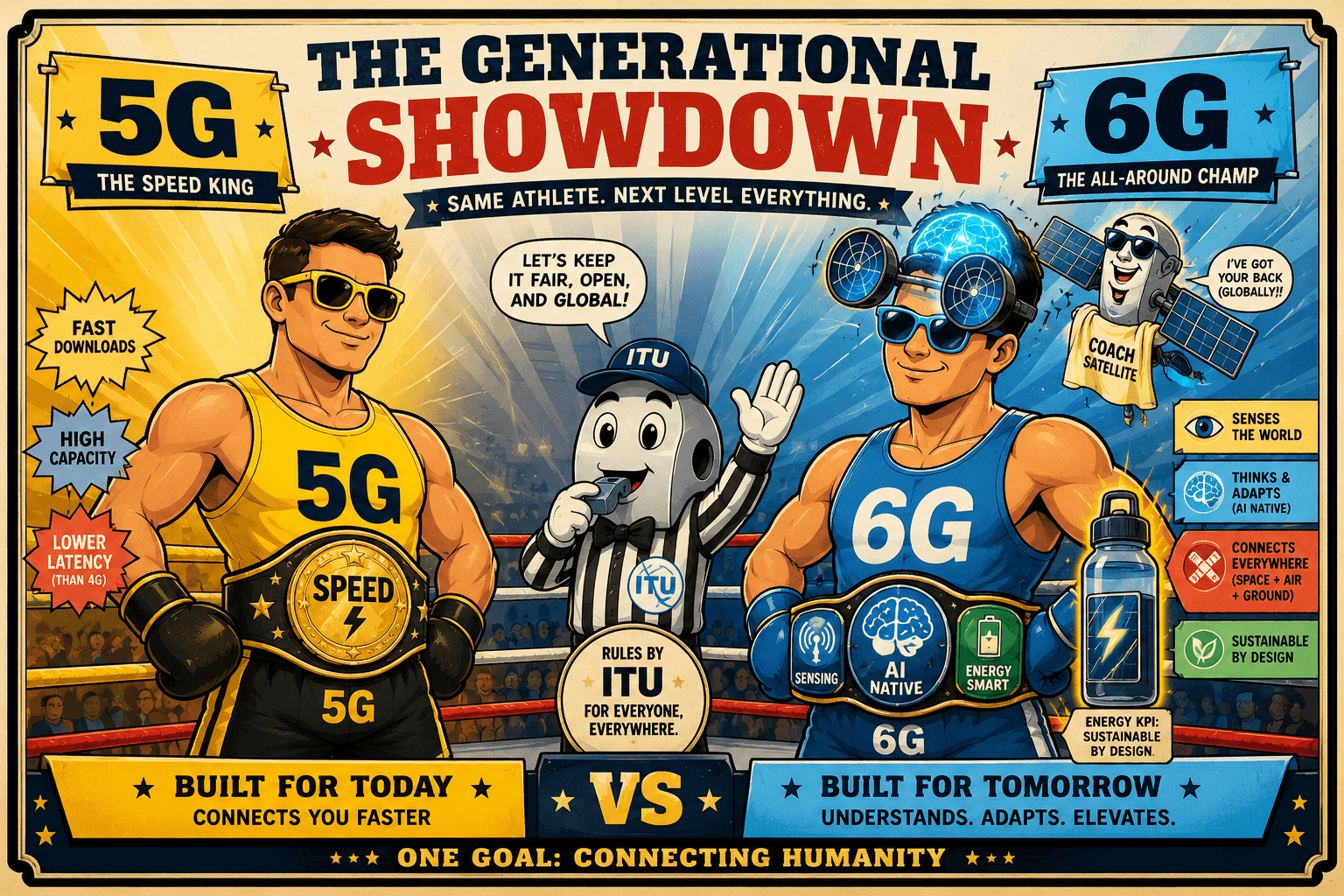
A boxing-style generational showdown presents 5G as the speed-and-capacity champion and 6G as an all-around system adding sensing, AI-native adaptation, global satellite coverage, and sustainable energy design.
Figure 10.1

Lesson 10.2: The Road Ahead: What Happens Between Now and 2030

Here's the itinerary, assembled from everything you've learned:
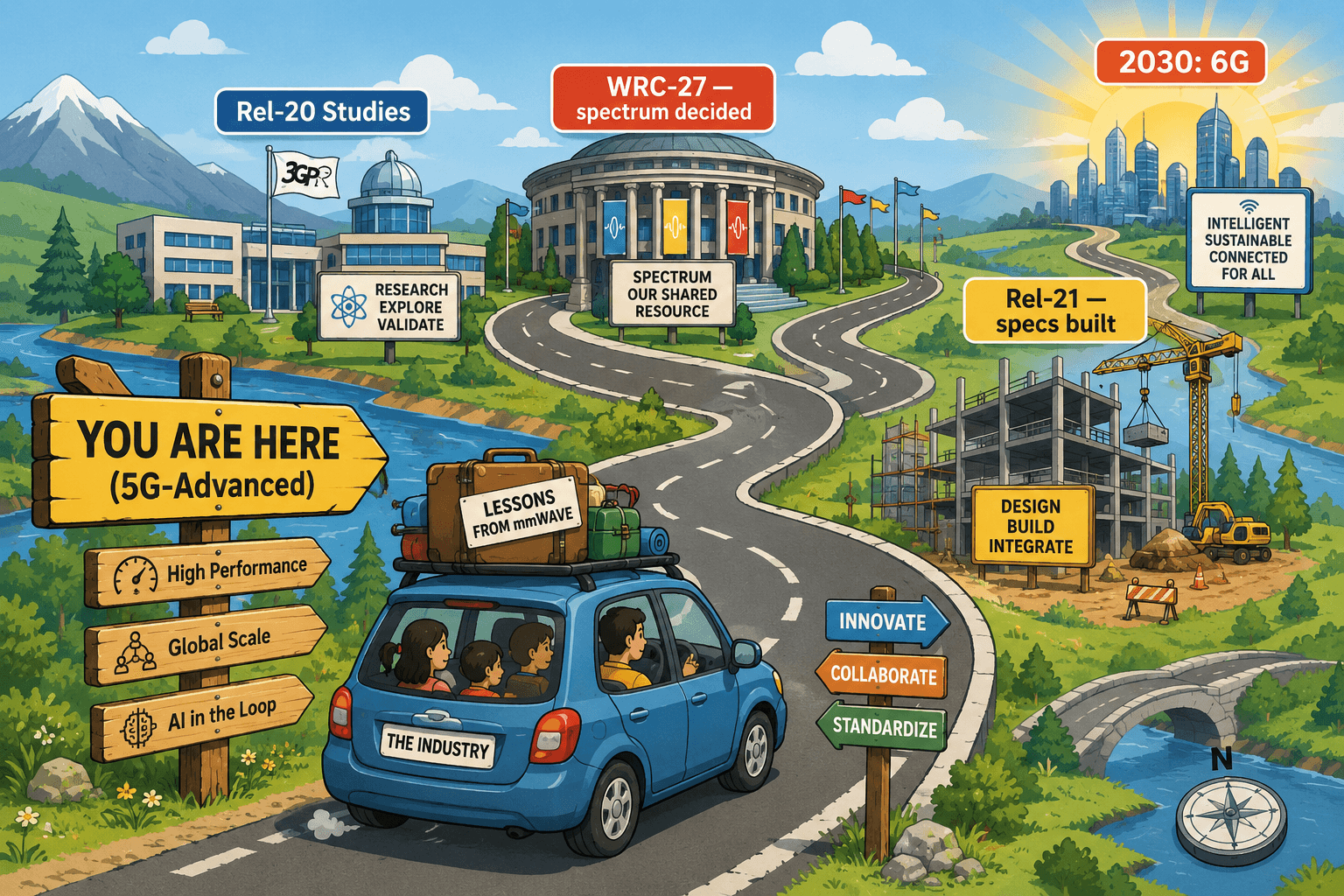
  • 2024–2026, 5G-Advanced era (Rel-18/19): the bridge. XR-awareness, AI/ML in the air interface, Ambient IoT beginnings, ISAC channel studies, 6G's homework done inside 5G's house.
  • 2025–2027, Rel-20 (6G study phase): committees evaluate candidates: FR3 usage, Giga-MIMO designs, AI-native architecture, ISAC integration. Everything is a proposal; nothing is a promise.
  • 2027, WRC-27: countries vote on spectrum, the FR3 golden bands' global fate gets substantially decided here. Watch this one.
  • ~2027–2029, Rel-21 (first 6G specifications): study becomes law. Vendors build to spec; trials scale up.
  • ~2030, Commercial launch: on the decade rhythm, aligned with IMT-2030. Early networks lean on 5G infrastructure while 6G layers arrive (nobody bulldozes a working network).
The industry drives from 5G-Advanced toward 2030, passing Release 20 research, WRC-27 spectrum decisions, and Release 21 design and specifications before reaching commercial 6G.
Figure 10.2

Lesson 10.3: Why Any of This Matters: The View from Outside

Strip away the acronyms and 6G is a bet on four human improvements.

  • Safety: networks that sense falls in an elderly parent's home without cameras, spot drones over stadiums, warn drivers about what's around the blind curve, and stay alive through hurricanes.
  • Presence: grandparents life-size in the living room from 2,000 miles away; a specialist surgeon's hands available in any rural hospital.
  • Inclusion: connectivity that follows and reaches people into deserts, oceans, and disaster zones, closing the gap for the billions the tower grid never reached.
  • Stewardship: more digital life carried on less energy, with every item in the economy trackable enough to actually recycle.

And for you, the engineer or PM who just finished this course, it means you can now sit in the meeting, hear 'the Rel-20 ISAC study is converging on FR3 monostatic sensing with Giga-MIMO arrays,' translate it in your head ('the 6G radar studies favor the golden bands, using the tower's own huge antenna to both send and listen'), and ask the question that actually matters.

That's the whole superpower this course promised. Go use it.
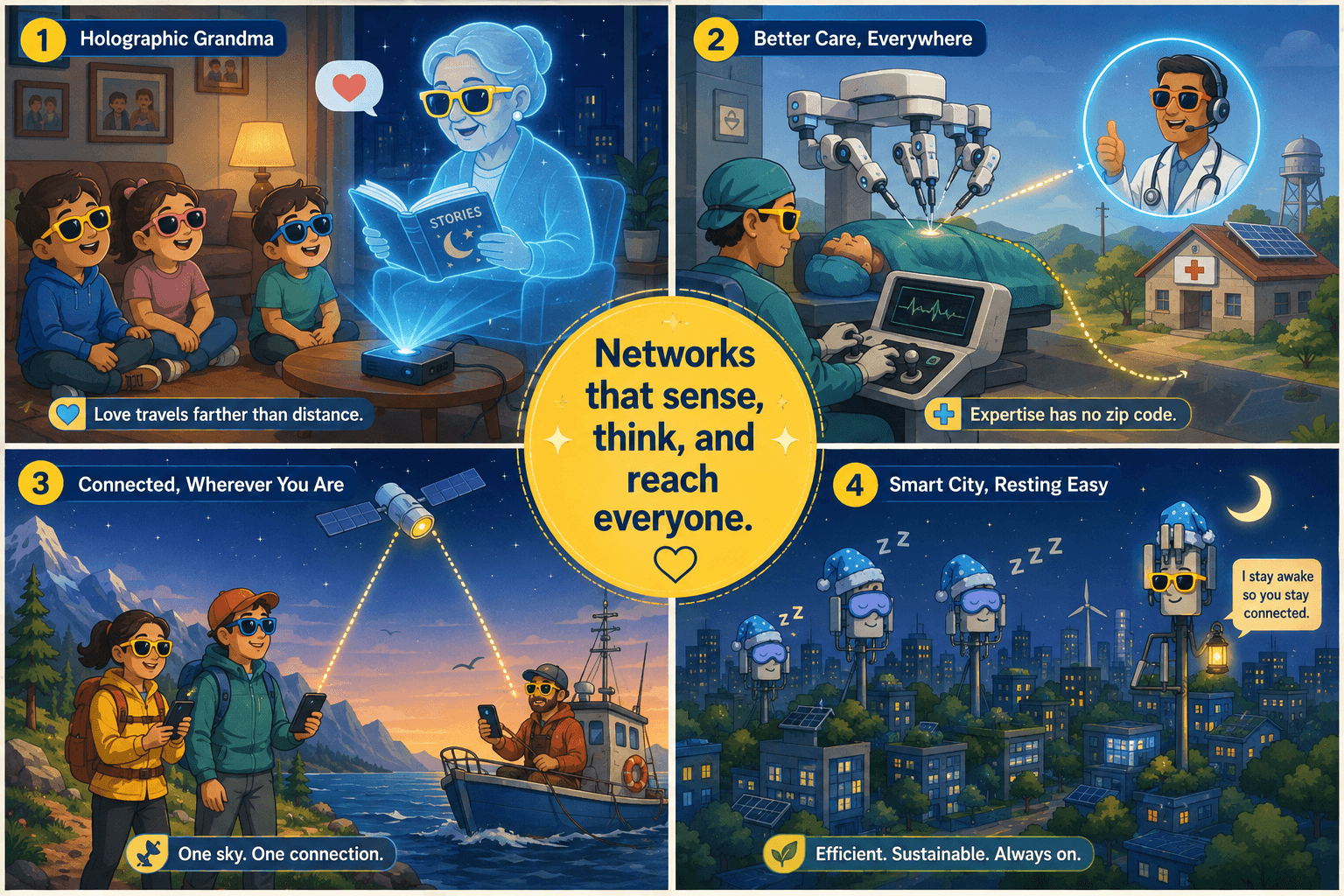
Four human outcomes show a holographic grandmother visiting children, remote expertise guiding rural surgery, satellite connectivity reaching mountains and water, and an energy-efficient smart city keeping essential coverage awake.
Figure 10.3

Keep this handy

Acronym Decoder : Module 10

AcronymStands ForEasy Explanation
5G-AdvancedNot an acronym, Rel-18/19 branding5G's final, most polished form (Releases 18–19), the bridge generation carrying early 6G homework like ISAC studies and AI/ML in the radio.
Study item vs. Work item3GPP work typesA study item asks 'is this feasible?' (research, reports). A work item says 'we're building it' (binding specifications). Rel-20 6G = studies; Rel-21 = specs.
WRCWorld Radiocommunication ConferenceThe ITU's global summit (every ~4 years) where countries decide which spectrum bands to allocate. WRC-27 is the one 6G watchers circle on their calendars.
IMT-2030 (revisited)The ITU's 6G frameworkThe requirements 6G must meet, the finish line every module in this course has been pointing at.
InteroperabilityNot an acronym, the whole pointAny phone, any network, any country, it just works. The quiet miracle that standards bodies like 3GPP exist to protect.

5G-Advanced

Stands For
Not an acronym, Rel-18/19 branding
Easy Explanation
5G's final, most polished form (Releases 18–19), the bridge generation carrying early 6G homework like ISAC studies and AI/ML in the radio.

Study item vs. Work item

Stands For
3GPP work types
Easy Explanation
A study item asks 'is this feasible?' (research, reports). A work item says 'we're building it' (binding specifications). Rel-20 6G = studies; Rel-21 = specs.

WRC

Stands For
World Radiocommunication Conference
Easy Explanation
The ITU's global summit (every ~4 years) where countries decide which spectrum bands to allocate. WRC-27 is the one 6G watchers circle on their calendars.

IMT-2030 (revisited)

Stands For
The ITU's 6G framework
Easy Explanation
The requirements 6G must meet, the finish line every module in this course has been pointing at.

Interoperability

Stands For
Not an acronym, the whole point
Easy Explanation
Any phone, any network, any country, it just works. The quiet miracle that standards bodies like 3GPP exist to protect.

Knowledge check

Check Yourself : 5-Question Quiz

Questions

  1. 1. Name the three genuinely NEW capability areas 6G adds beyond 'faster 5G.'
  2. 2. What's the difference between a 3GPP study item and a work item, and which Releases map to 6G's?
  3. 3. Which spectrum range is 6G's headline new home, and what makes it 'golden'?
  4. 4. Pick any three rows of the 5G-vs-6G table and restate them from memory.
  5. 5. A vendor tells you their product is '6G-ready' in 2026. What's the professionally polite response?