XR
- Stands For
- Extended Reality
- Easy Explanation
- The umbrella term covering VR, AR, and MR, any tech that blends digital content with what you see.
Module roadmap
What are XR, VR, AR, and MR?
The "R" in all of these acronyms stands for Reality.
Here is the quick breakdown of what they mean:
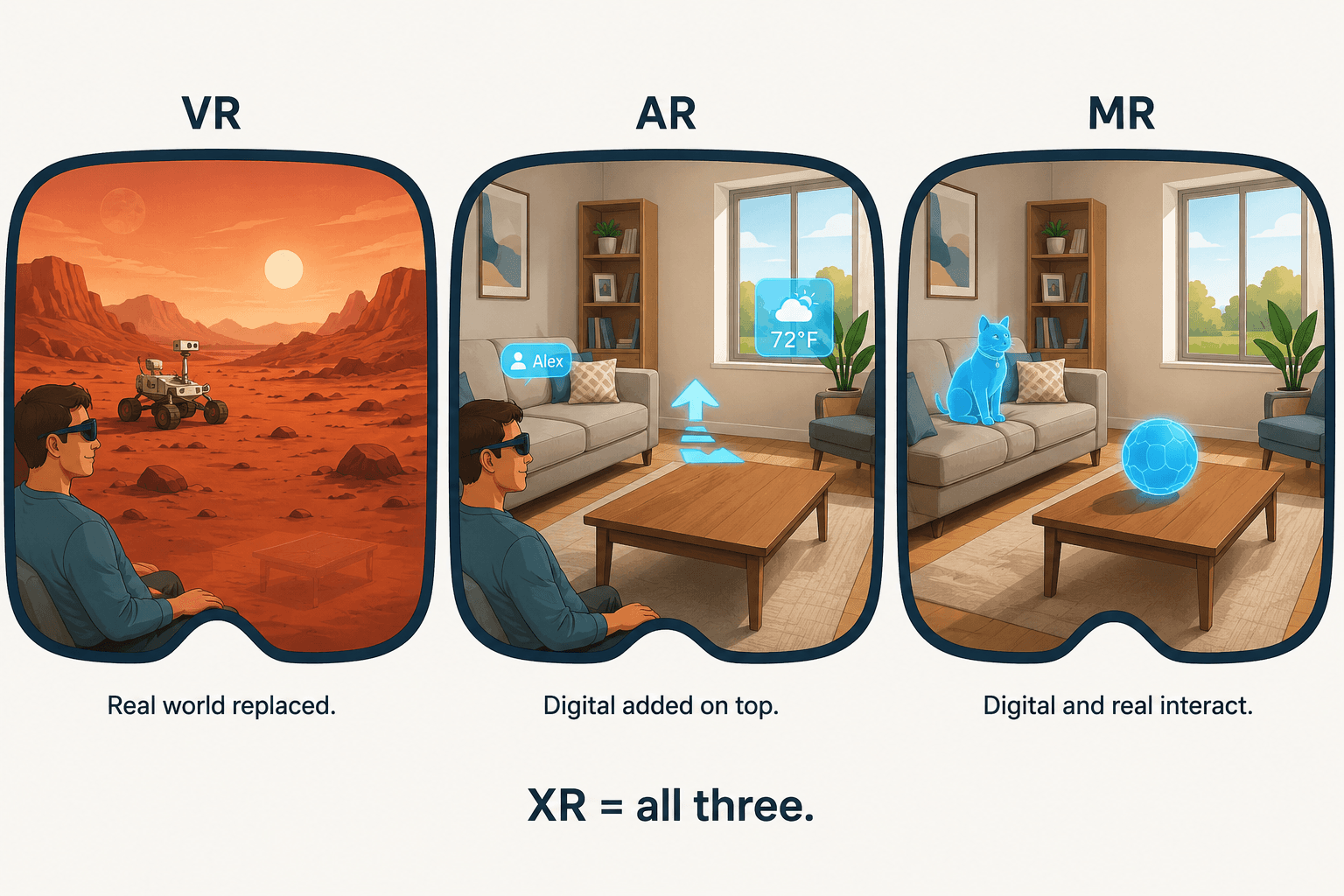
VR (Virtual Reality): You wear a headset that completely blocks out the real world and puts you inside a 100% digital, video-game-like world.
AR (Augmented Reality): You look through a screen or glasses (like Pokémon GO or Snapchat filters) that overlay digital objects right on top of the real world.
MR (Mixed Reality): An advanced mix of both, where digital objects don't just sit on top of your view but can actually interact with the real world (like a virtual ball bouncing off your physical bedroom wall).
XR (Extended Reality): The catch-all umbrella term that covers all three of the technologies above (VR, AR, and MR).
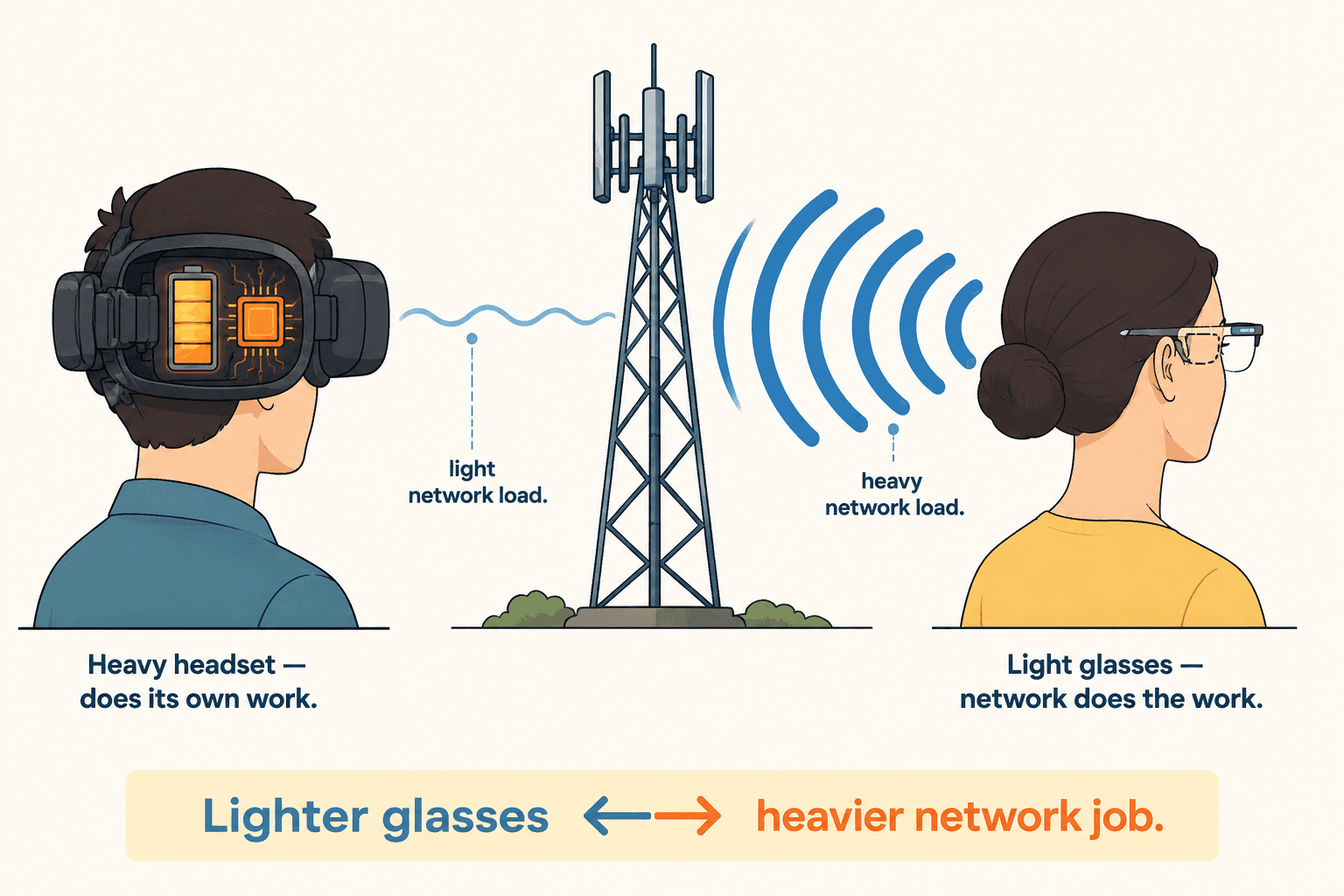
The device family ranges from bulky VR headsets to featherweight AR glasses. But this is the lemon twist: the lighter the glasses, the heavier the network's job. Small frames can't hold large batteries or hot chips, so rendering must happen elsewhere, at the network edge, and be streamed back instantly.
Your inner ear tracks your head's motion with ferocious precision. When you turn your head, your eyes expect the view to update within roughly 10–20 milliseconds, about one-tenth of an eye blink. Any slower and your brain declares 'poison!' and makes you nauseous. (Your brain’s motion-sickness alarm predates VR by a few million years.)
This is why streaming a movie is easy, but streaming reality is brutal. A movie can buffer 30 seconds ahead, the network can be sloppy, and you'd never know. But nobody can buffer your head movements, because nobody knows where you'll look next. Every head turn is a live, unforgiving deadline.
Two numbers matter here.
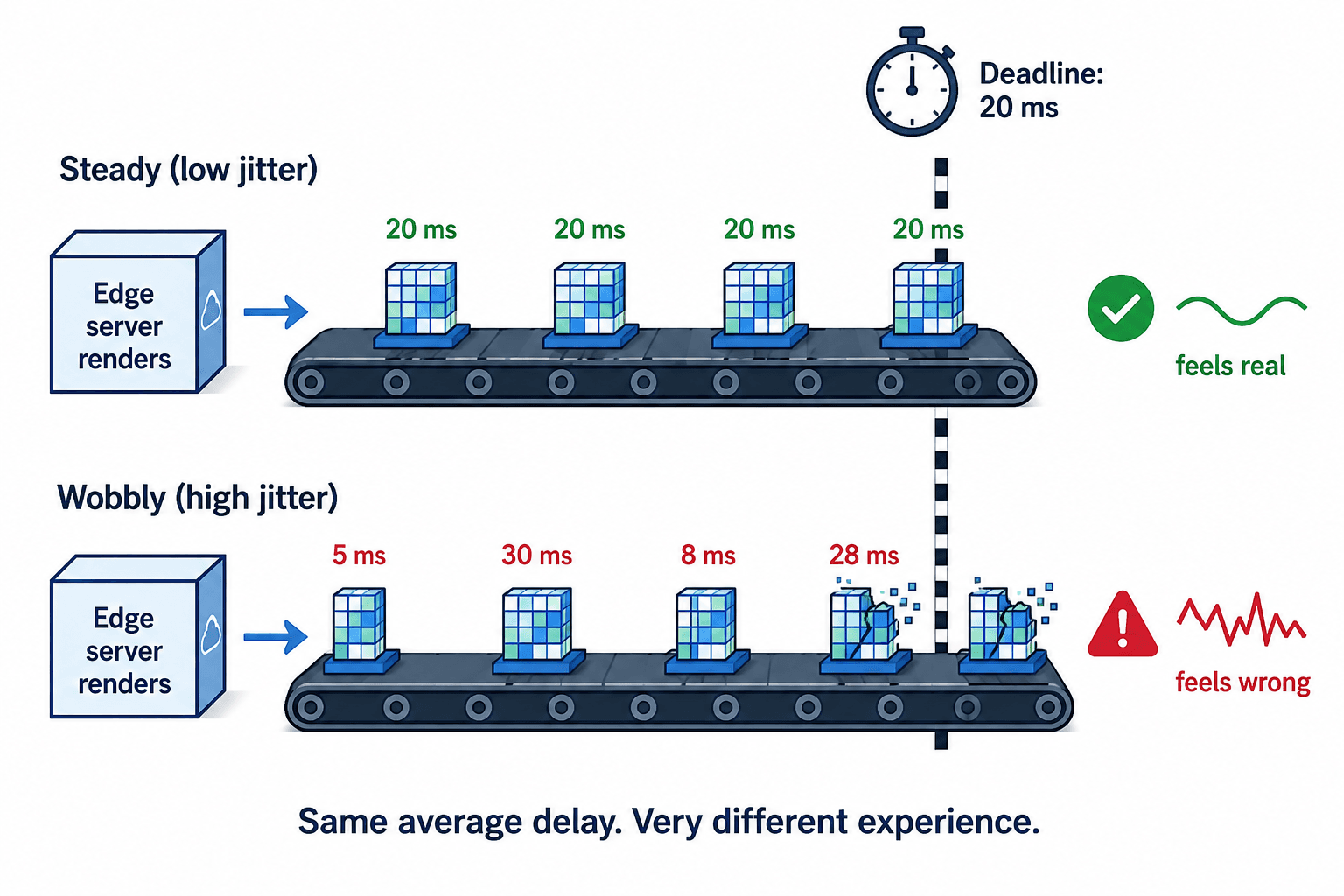
E2E latency (end-to-end latency) is the full round trip: head turns → sensors report → edge computer renders the new view → pixels arrive at your eyes.
Jitter is how much the delay wobbles. Weirdly, a steady 20 ms delay feels better than one that bounces between 5 and 30 ms. Your brain adapts to consistency but hates surprises. Great QoE (Quality of Experience) means low latency and low jitter.
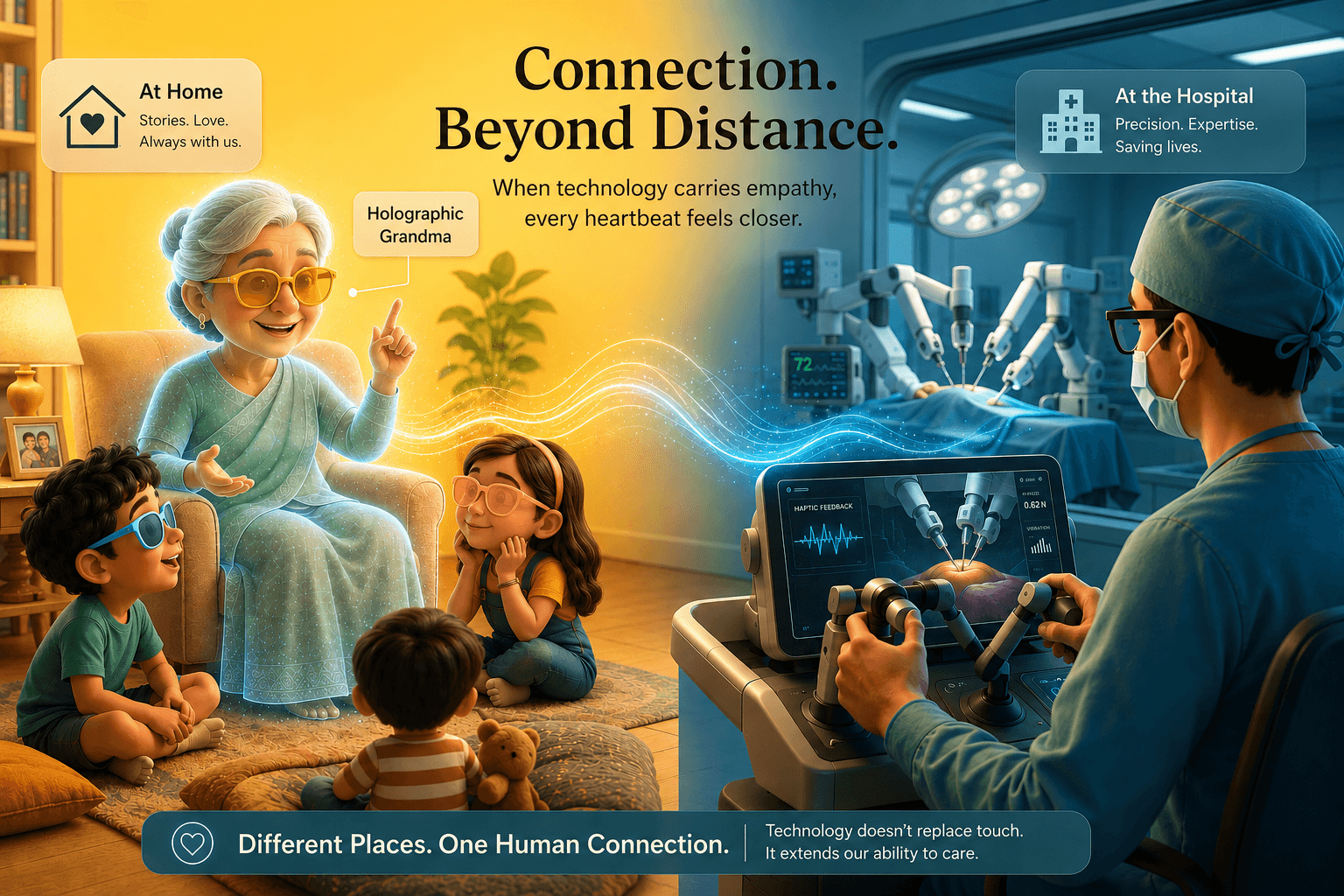
Video calls flattened us into rectangles. Holographic communication aims to put grandma in the room: a life-size, 3D, look-around-able presence. The data appetite is enormous: capturing a person volumetrically (from all angles, in depth) can require hundreds of times as much data as HD video. Clever compression and AI-based reconstruction (send a sketch, let AI at the far end fill in the details) bring it down to something a 6G link can carry.
Beyond sight and sound, 6G research talks about the internet of senses: transmitting touch (haptics, a surgeon feeling tissue resistance through a robot), precise motion (6DoF pose, position plus orientation, covered in Module 2's decoder), and eventually multi-sensory streams. Touch is the brutal one: your fingertips notice delays even smaller than your eyes do, which is why remote surgery and remote machinery are flagship 'hyper-reliable, low-latency' use cases in the IMT-2030 vision (Module 1).
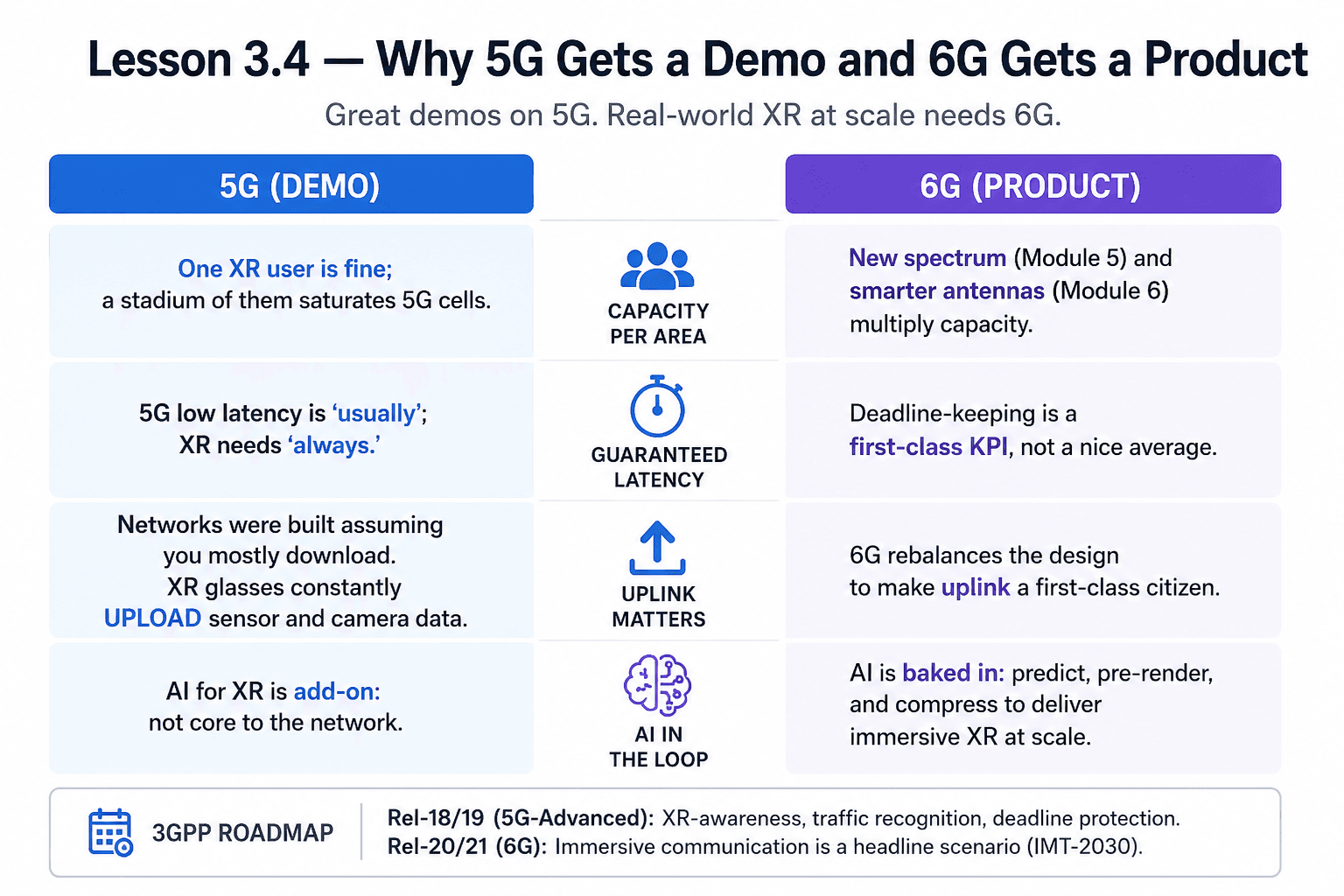
5G can absolutely run impressive XR demos, in a lab, near a tower, with few users. The problems appear at scale:
3GPP has been grooming this path: Rel-18/19 ('5G-Advanced') added XR-awareness features, the network learns to recognize XR traffic and protect its deadlines. Rel-20/21 6G work aims to make immersive communication a headline scenario, exactly as the IMT-2030 hexagon promises.
Keep this handy
| Acronym | Stands For | Easy Explanation |
|---|---|---|
| XR | Extended Reality | The umbrella term covering VR, AR, and MR, any tech that blends digital content with what you see. |
| VR | Virtual Reality | Fully digital world. Put on the headset, and your living room disappears, and you're on Mars. |
| AR | Augmented Reality | Digital layers on the real world, like navigation arrows painted on the actual street through your glasses. |
| MR | Mixed Reality | AR's ambitious sibling: digital objects that interact with real ones, a virtual ball that bounces off your real table. |
| HMD | Head-Mounted Display | The headset or smart glasses themselves. The lighter they get, the more network work must move off the device. |
| QoE | Quality of Experience | How good it feels to the human, smooth, sharp, no nausea. Different from raw speed: a fast network can still deliver a queasy experience. |
| E2E latency | End-to-End latency | The total delay from your action (turning your head) to the result (the view updating). The full round trip, not just one leg. |
| Haptics | Not an acronym, touch feedback | Technology that lets you FEEL digital things: vibration, pressure, texture. The 'sense of touch' channel of communication. |
Knowledge check